
Halfcycle vs Emergent: an Emergent alternative for software you own
Both turn a description into working software. They are built for different purposes and different people, they give you different levels of control, and they leave you with different things at the end.
-
Free for solo developers
The whole process and every check, at no cost. The agents run on your own Claude or OpenAI account.
-
More features, more control
A whole team of AI agents, a written plan, every piece reviewed and the app tested. Your code, your choice of tools, live wherever you choose.
-
Built for production from day one
Planned with a real architecture, built with what suits the project, and put live on hosting chosen for how many people will use it.
Emergent is an AI app builder: you describe a web or mobile app in the browser, its agents build and test it, and it runs on Emergent's built-in hosting with a database already set up. It is in the same family as Lovable, Bolt and Replit. Halfcycle is an Emergent alternative for software you own: a team of AI agents plans, builds, checks and tests it inside Claude Code or OpenAI Codex, with whatever tools suit the job, and the code stays in your own repository.
At a glance
| Feature | Emergent | Halfcycle |
|---|---|---|
| Cost | A free plan with 10 credits a month; Standard $20 a month and Pro $200 a month (prices change: check Emergent's site) | Free for solo developers |
| What it is | An AI app builder in the browser, with built-in hosting | A well-researched process that builds your software with a team of AI agents, using your own Claude Code or OpenAI Codex (OpenCode coming soon) |
| Made for | Turning an idea into a working web or mobile app, with nothing to set up | Anyone, developer or not, building software that has to last and needs real thought before it is built |
| Where you work | Emergent's website | Your terminal and your Claude Code or Codex, in your own repository (the folder that holds your project's code) |
| What it is built with | A fixed set of tools: its site names React, Node.js or FastAPI, and MongoDB | Whatever is best for your project. Our own run used Go and SQLite |
| Where the app lives | On Emergent's built-in hosting; your own cloud on its Enterprise plan | Anywhere you choose to put it live |
| Who owns the code | Saved to GitHub on paid plans; its site says you own it | You do, from the first line, in your own folder |
| Before anything is built | On the Pro plan, its newest builder (in beta) interviews you and writes a phased plan for approval | It asks the questions a software team would ask, then writes down what to build and how, and has that checked |
| Deciding how much process a job needs | Set by your plan: the builder that plans first is on Pro | Halfcycle's: it sizes each change from the parts it touches and tells you why, from a quick one-session fix to the whole team, or a quick prototype when you ask for one |
| Checking the work | Automated tests, and on the Pro plan a testing agent that clicks through the app; no separate review of the code is described | Each piece is checked by a different agent before it is added, and another agent clicks through the finished app in a browser, the way a person would |
| Software you already have | Can pull in an existing GitHub repository | Reads your existing code and carries on from where it is |
| Database, logins, hosting | Database and hosting built in | Recommended for your project, then set up as part of the plan, with step-by-step guidance |
| Documents you keep | Its site does not describe planning documents saved to your project | A product spec, the architecture, the phases and a design for every component, saved in your repository |
| Learning from other projects | Not described on Emergent's site | When a project goes wrong in a new way, what caused it and what fixed it both reach your project automatically |
| Coding needed | None | None. You answer its questions in plain language; you need Claude Code or OpenAI Codex installed |
| The AI itself | Included in Emergent's credits | Runs on your own Claude or OpenAI account, as part of your normal usage |
The real difference: how it gets built, and what you keep
Most comparisons of AI app builders count features. Two questions matter more: who thinks about what could go wrong before it is built, and what you hold when the building stops.
Emergent
- You describe the app in a browser
- Emergent's agents build and test it
- It runs on Emergent's hosting, with its database, built with its own set of tools. The code can be saved to GitHub on paid plans
Halfcycle
- You say what you want, in plain words
- It asks what a software team would ask, then writes the plan
- A team of AI agents builds it, piece by piece
- Another set of AI agents checks each piece; another agent clicks through the finished app in a browser
- Your own code, yours to keep and put live wherever you choose
Emergent comes closer than most app builders to working like a team. Its agents build and run automated tests, and its newest builder, on the Pro plan and in beta, starts by interviewing you and writing a phased plan before anything is built. The rest is a platform: the app runs on Emergent's hosting, on a database Emergent sets up, built with the same set of tools every time. The code can be saved to GitHub on paid plans, and its site says you own it.
Halfcycle does all of that too, on every project rather than on a top plan: questions and a plan whenever the work needs them, tests as it builds, and an agent clicking through the finished app. It adds what Emergent does not describe: the plan and designs written down in your repository, and every piece of code reviewed by a separate agent before it is added.
Halfcycle is not a platform. It works inside Claude Code or OpenAI Codex on your own computer and works like a software team made of AI agents. Before anything is built, it asks the questions a product owner, an architect and a senior engineer would ask, and writes down the answers as the plan. Then a team of AI agents builds the software piece by piece, another set of AI agents check every piece, and the finished app is tested. What you end up with is ordinary code in your own folder, built with whatever suits the job, that you can put live anywhere.
What Emergent does well
Emergent has some good ideas, and they deserve credit.
- Nothing to set up. Hosting and a database come ready, so a description becomes a running app. Halfcycle does this too: there is nothing for you to set up, you run one command and describe what you want. For the database, logins and hosting it suggests options that take minutes to set up, and sets them up as a step in the plan.
- Testing built in. Automated tests run as it builds, and on the Pro plan a testing agent clicks through the app the way a person would. Halfcycle does this too, on every project: tests run as it builds, and when a phase is finished an agent that built none of it clicks through the live app in a browser.
- A plan before the build, on Pro. Its newest builder interviews you and writes a numbered, phased plan you approve. Halfcycle does this too, whenever the work needs it: it asks its questions one at a time and writes the plan, the architecture and a design for each part into your repository for you to approve.
- Web and mobile. It builds both.
- Your own cloud for larger companies. Its Enterprise plan can run apps in a company's own cloud. With Halfcycle the app goes live wherever you choose, your own cloud included.
Emergent's limits: tools, plans and checking
What to ask before building something you need to keep on Emergent. The answers come from Emergent's own website, pricing page and blog.
Can you choose what Emergent builds with?
Its site describes one set of tools: React for the screens, Node.js or FastAPI behind them, and MongoDB for the data. It does not describe choosing others. If your software needs something different, or has to fit a system you already run, that choice has been made for you.
Which plan gets the planning and testing agents?
The builder that interviews you, writes the phased plan and tests by clicking through the app is on the Pro plan, at $200 a month, and Emergent describes it as in beta. Saving your code to GitHub starts on the Standard plan; the free plan does not list it.
Who checks the code?
Emergent's tests check that the app works, and so do Halfcycle's. Its site does not describe a separate agent reading each piece of code against a plan before it is added, which is where problems that do not show on screen are found. Halfcycle has one.
Where Halfcycle is the stronger choice
The examples below come from a real project we built with Halfcycle: Hookbox, a small service that receives payment notifications from Stripe and keeps them safe, so that none get lost if the system that should handle them is down.
You don't need to know how big the job is
Most people can't tell whether what they are asking for is a five-minute tweak or a week of work, and they shouldn't have to. Halfcycle works it out for you. Before it touches anything, it looks at which parts of your software the request affects, then tells you which of three ways it will go, and why:
- A small change, like new wording on a button or a fix on one screen, goes straight through in one session. No plan to approve and no documents to read. It is still reviewed twice by an agent that did not write it, and tested.
- A change that reaches across parts, like adding an age field that the form, the server and the stored data all need to know about, gets a short plan for you to approve and a check of the result.
- Something bigger, a new product or a major feature, gets the whole team: the questions, the full plan, the designs, the build and the tests, unless you have asked for a quick prototype first.
If a small change turns out bigger than it looked, it moves itself up to the right path and tells you. You can ask for more care on anything, and it won't skip a step a change needs. So quick things stay quick, and you only sit through the questions when the work calls for them.
And if all you want right now is a quick prototype, say so. Halfcycle builds a quick version to try, and when it suggests where the data, the logins and the hosting should live, it picks options that take minutes to set up rather than days. If the prototype proves itself, the same project carries on with the full process from there.
It finds the problems before anything is built
An app builder starts building from your description. Halfcycle starts by working out what you are really building. It asks one question at a time, gives a recommended answer and the reason, and raises the problems you would not know to look for. On Hookbox it found six of them before a single line of code was written.
One is shown below. Hookbox was meant to let you resend a payment notification later if it had failed the first time. But Stripe's notifications carry a time stamp that expires after five minutes, so a resent one would have been rejected as fake. Halfcycle spotted it, explained what each fix would cost, and recommended one.
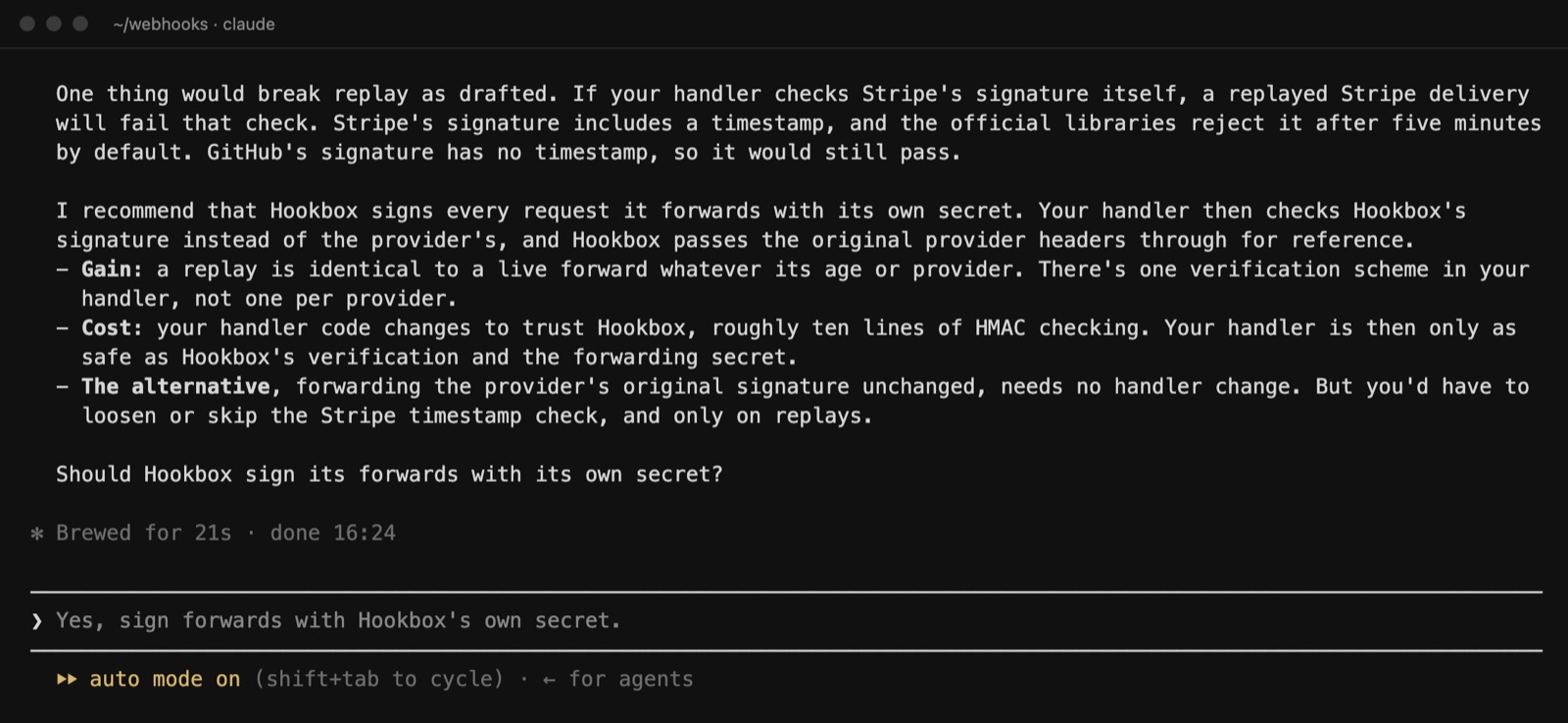
The others included Hookbox quietly switching off Stripe's own resending, a goal nobody would have been told was failing, and whether to build it at all instead of using an existing tool. Emergent's top-plan builder does interview you first, which is the right instinct; the difference is that Halfcycle does it on every project and keeps the answers as documents.
It knows more with every project, yours included
Halfcycle keeps learning. When a software project goes wrong in a new way, two things are kept: what caused it, and what fixed it. Both reach every other project automatically, with nothing for you to download or update.
For you, that means two things. Most of the problems other projects have already run into never arrive on yours at all. And the ones that do arrive come with the fix already known, because somebody has already found it. The more projects it works on, the longer that list gets.
What travels between projects is the shape of a problem, never your code or your documents, and we do not train on your work.
You get the documents a software team would write
A good software team writes things down before it builds, so that everyone, people and agents alike, works from the same picture. Halfcycle does the same, and every document is saved in your own repository as a plain file you can read, change and keep:
- The product spec. What you are building, who it is for, what success looks like, and the options you turned down and why.
- The architecture. The parts of the system and how they connect, with a diagram, plus the rules the system must keep to.
- The phases. The work cut into stages small enough to finish, with the riskiest part first and what "done" means for each.
- A design for every component in the phase. What each part does, how it behaves, and how anyone can check it works.
- The build plan and its record. Every task, who built it, who checked it, and what they found.
On Hookbox that came to a product spec, an architecture overview, three phase plans and seven component designs, among others. The agents read them at the start of every session, which is why the tenth task fits the first. Emergent's site describes a phased plan on its Pro plan, but not a product spec, an architecture or component designs saved as documents you keep.
docs/
├── product-spec.md            what it is, who for, what success looks like
├── architecture-overview.md   the parts, how they connect, the diagram
├── phases/
│   ├── poc.md                 the first phase and what "done" means
│   ├── phase-1.md
│   └── phase-2.md
├── features/                  one design per component
│   ├── stripe-receive.md
│   ├── delivery-store.md
│   ├── signed-forwarder.md
│   ├── inbox-minimal.md
│   └── …
└── build-records/ every task, every reviewA team of AI agents builds, another set of agents checks, and another agent tests
Once the plan is agreed, Halfcycle splits it into tasks in the order they can be done and hands them to a team of AI agents with different jobs, the way a real software team splits the work. Every one of them is an AI agent except you. Analyst and architect agents question the idea and design the system. Builder agents write the code, each on its own copy. A separate set of reviewer agents checks every piece before it is added to the project, and a tester agent checks the tests and runs quick checks that the finished app works. Two lead agents run the team. You approve the plan and accept the result.
When a phase is finished, one more agent, one that built none of it, opens the live app in a browser and walks through it the way a person would: signing in, clicking through each journey the phase was for, and checking what appears on screen. Anything it finds goes back to the team to fix, and the journeys are walked again until nothing is left in the way.
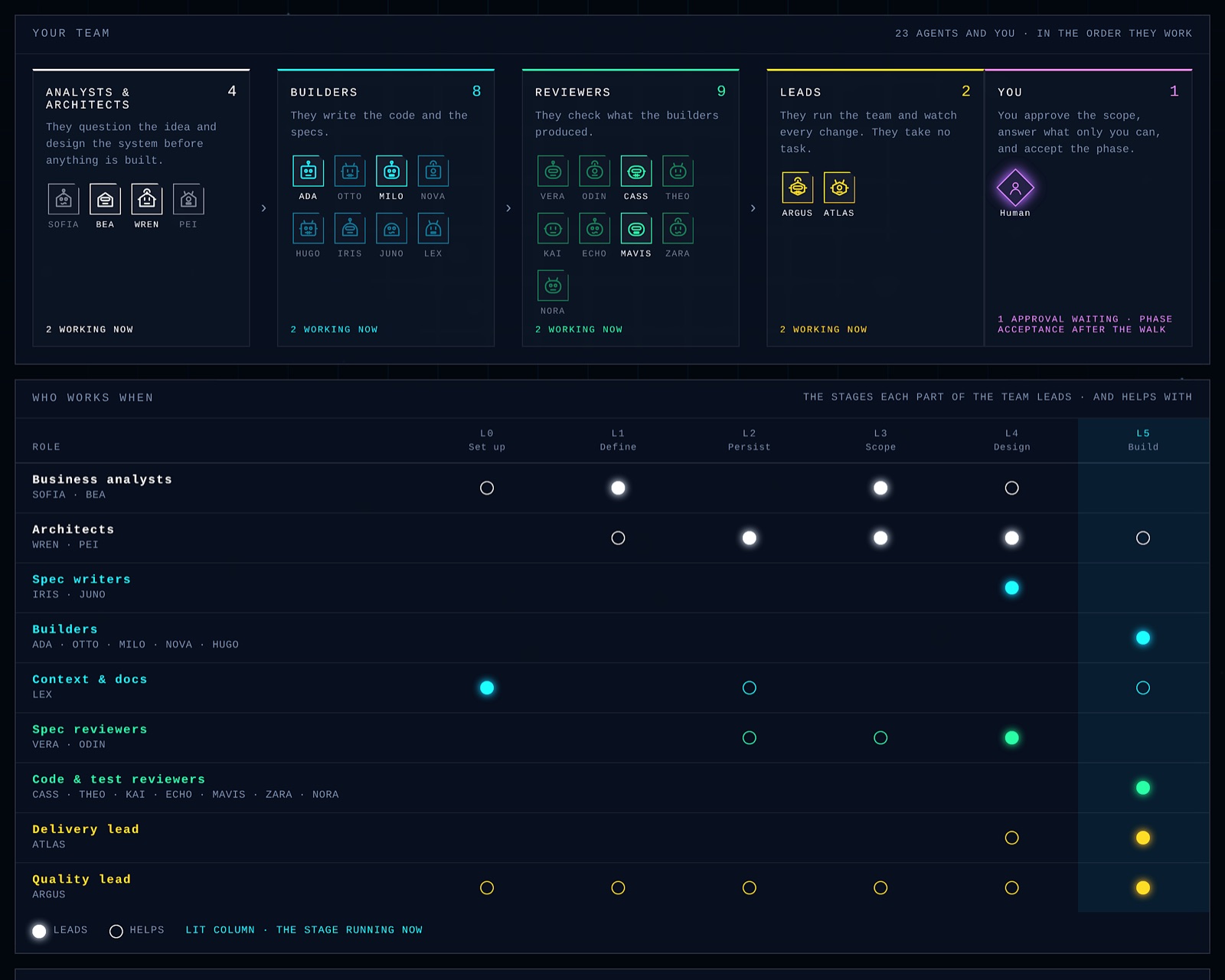
On Hookbox one check failed: the part that receives Stripe's notifications was tested with sample data that was missing something the plan required. It was fixed, checked again by a third agent, and passed. Two hours and eleven minutes after the building started, every task that did not need a person was built, checked and added. It stopped where it should, at the jobs only a person can do, like creating the Stripe test account, each with step-by-step instructions already written.
Security is planned in from the start
When software built with AI has a security hole, it is rarely one bad line of code. More often it is a gap between parts: a rule about who can see what, applied on one screen and missing from the next, or a test login quietly standing in for a real one. Halfcycle is built around those gaps.
- Who can sign in, and what each kind of user may see and do, is written into the plan once. Every part built afterwards has to follow it, and the reviewer agents check each piece against it.
- A missing login or secret key makes the app stop with an error, so a stand-in login cannot slip into the live app looking like a real one.
- How secret keys are kept is settled when the project is set up, and the project is checked against it, so keys do not end up in your code.
- The finished app is walked by an agent really signed in, on the live version, not on a test copy with the doors left open.
So security is part of how your app is designed and built, from the first plan to the live version, rather than a scan at the end that looks for holes once they are already there.
A console to watch your project being built
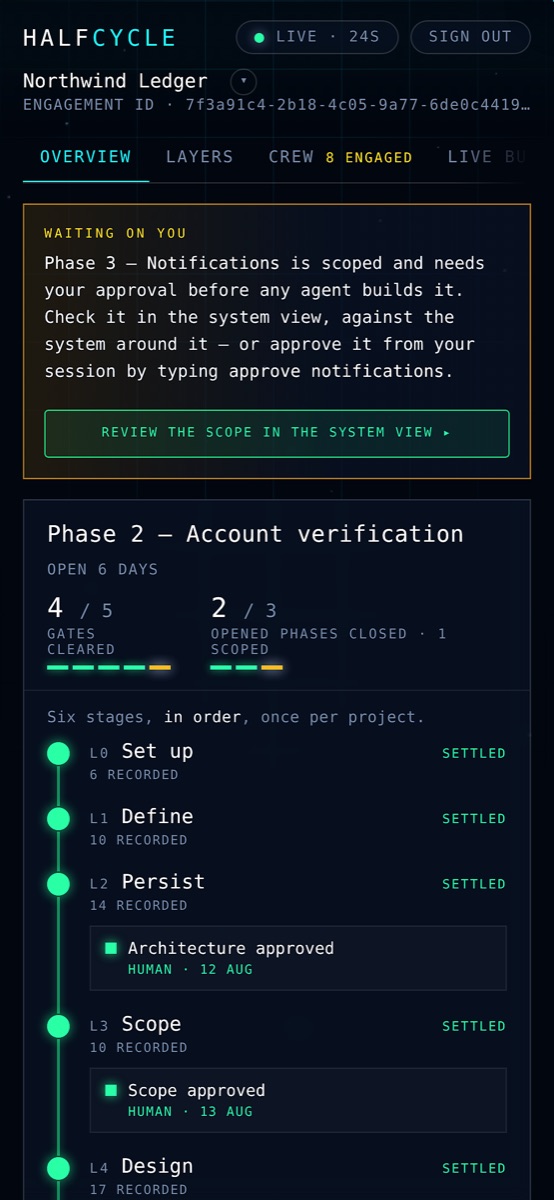
Every Halfcycle project gets an online console: a web page where you, or anyone you invite, can see the whole project without opening a terminal. Emergent shows you the app itself as it is built. The console shows you the work behind it: the plan, the team of agents, the system and the progress.
Where the project stands
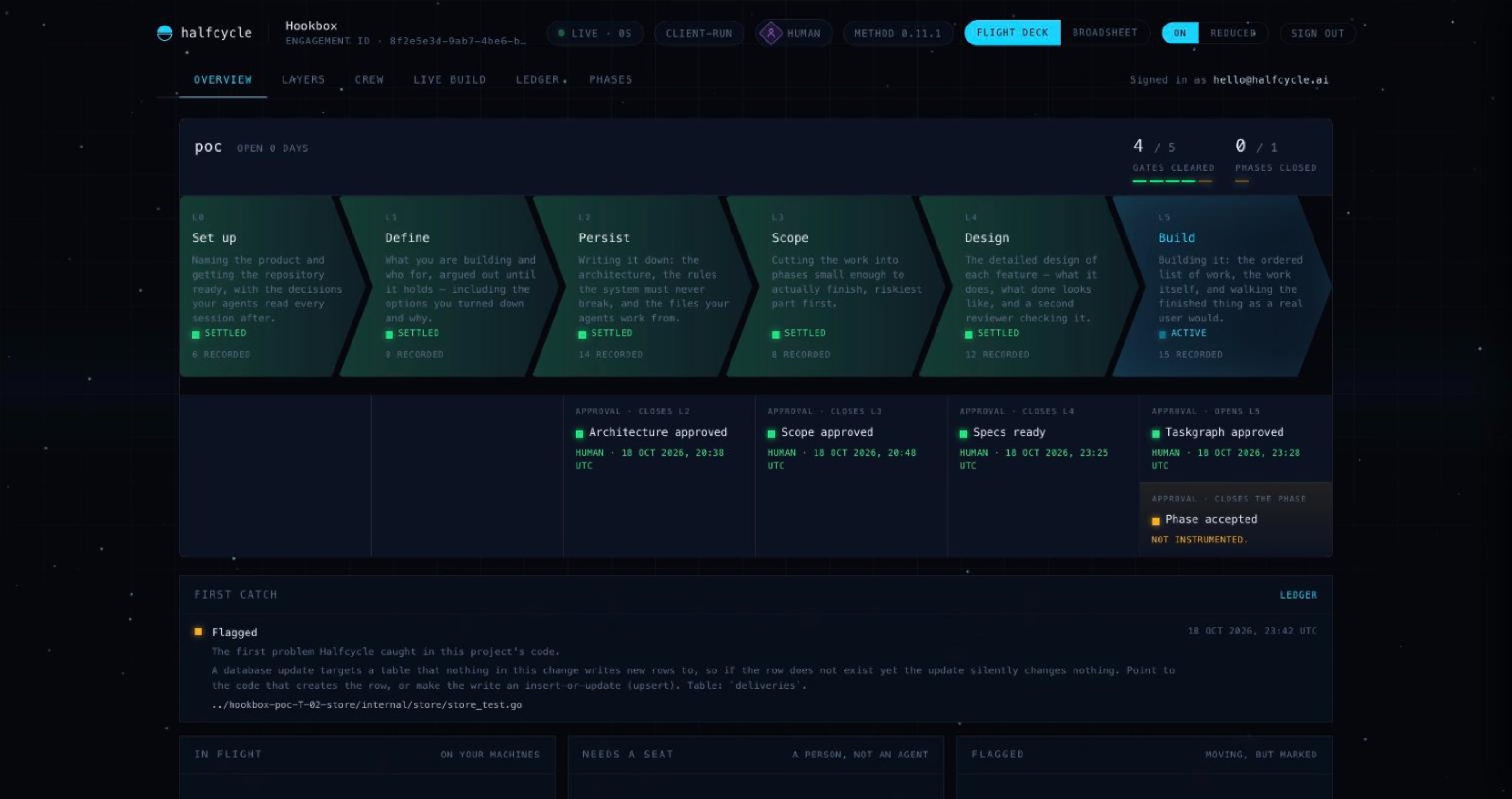
The overview shows each stage of the work, what was approved and when, and any problem the checks found in the code. The first one on Hookbox was a line of code that updated a record nothing had ever created, so it would have quietly done nothing at all.
The system design, and what each phase changes
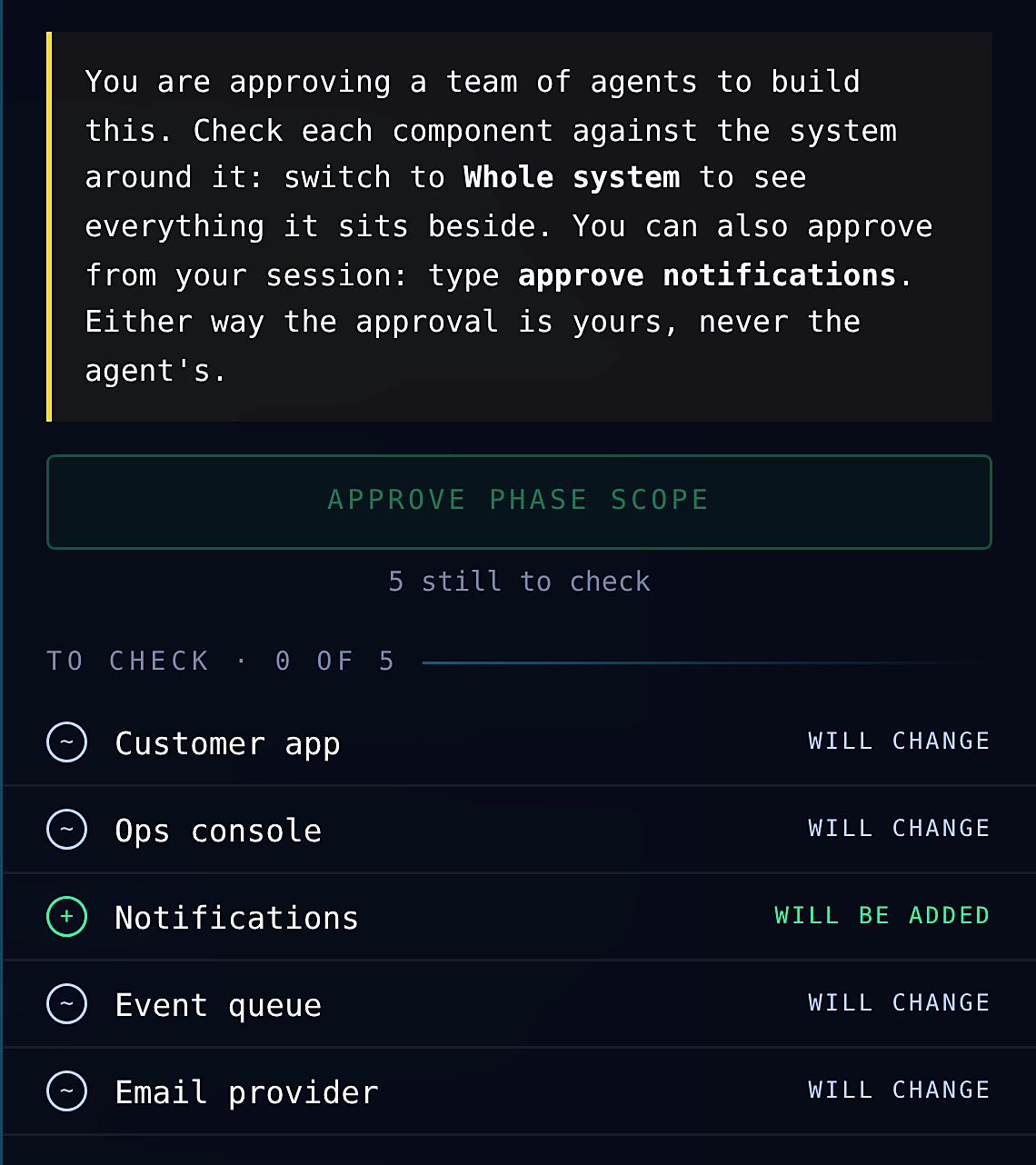
The system view draws your whole product as a diagram: the apps people use, the services behind them, the data and the outside services, with a card for each part. Before a phase is built you see exactly which parts it will add or change, and you approve them one by one. While it is being built, each card shows whether that part is built and checked, in progress, waiting for a person or blocked. It also shows two things that usually only come out at the end: a part that changed though the plan did not include it, and a part the plan needs that no task is building.
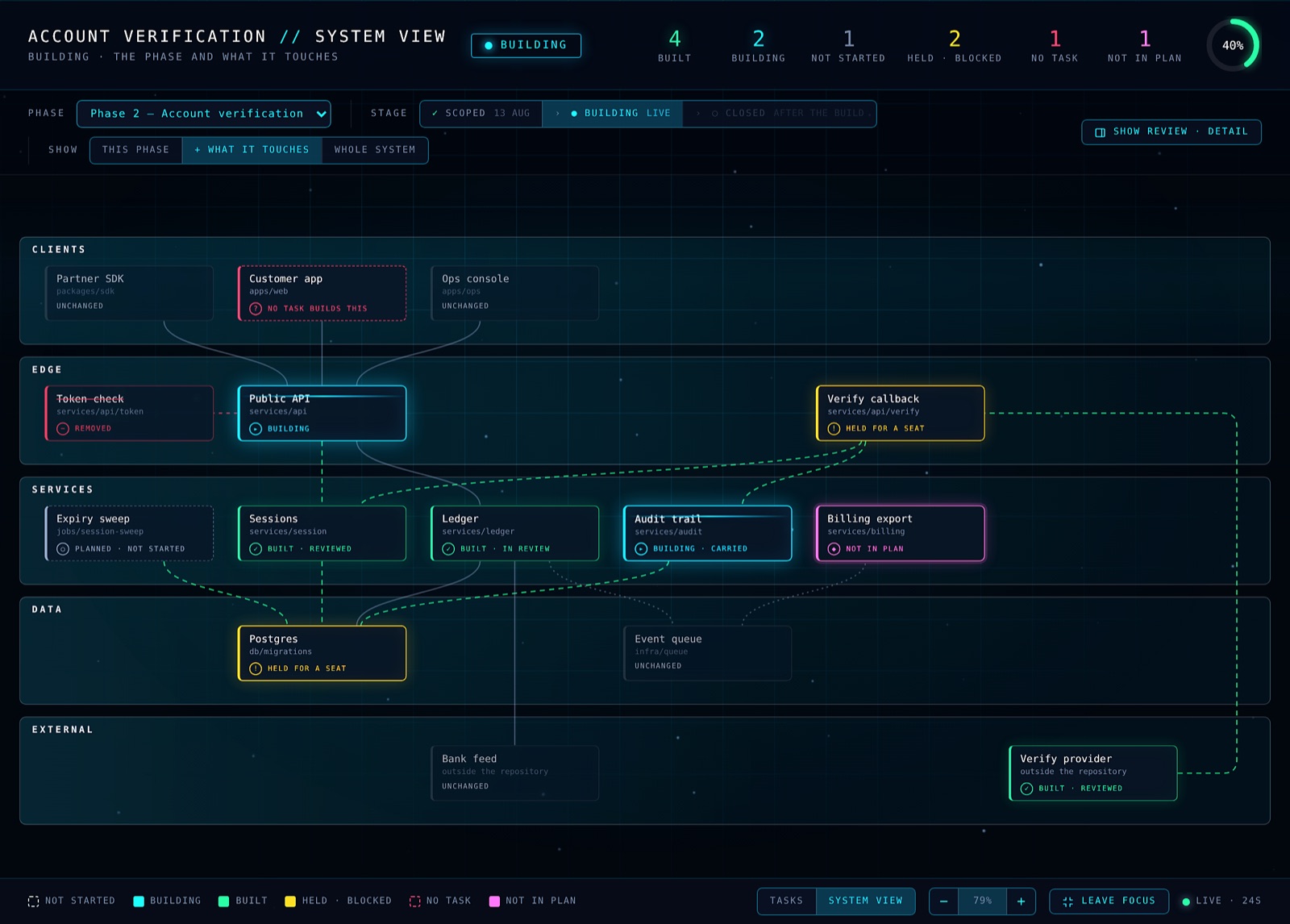
You approve each change before it is built
No agent builds a phase until you have approved it, part by part. The console lists every part of your system the phase will add or change. You check each one against the system around it, mark it Looks right or ask for a change in plain words, and the approve button stays off until every part is checked. You can approve from the console or by typing it in your coding agent; either way the approval is recorded as yours, with the time, never the agent's. If the plan changes after you approve, your approval is not carried over: only the parts that changed come back to you.
The live build, task by task
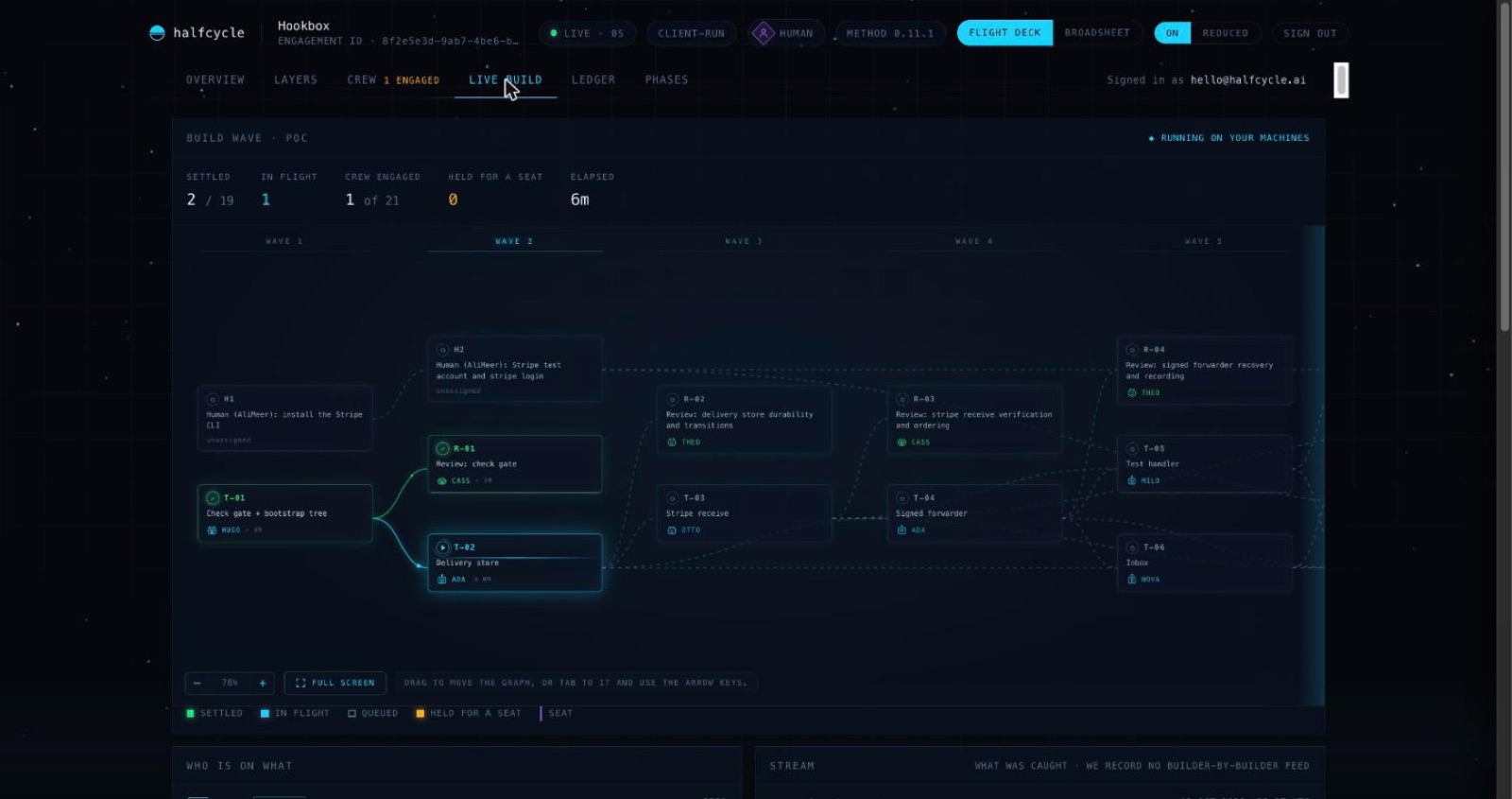
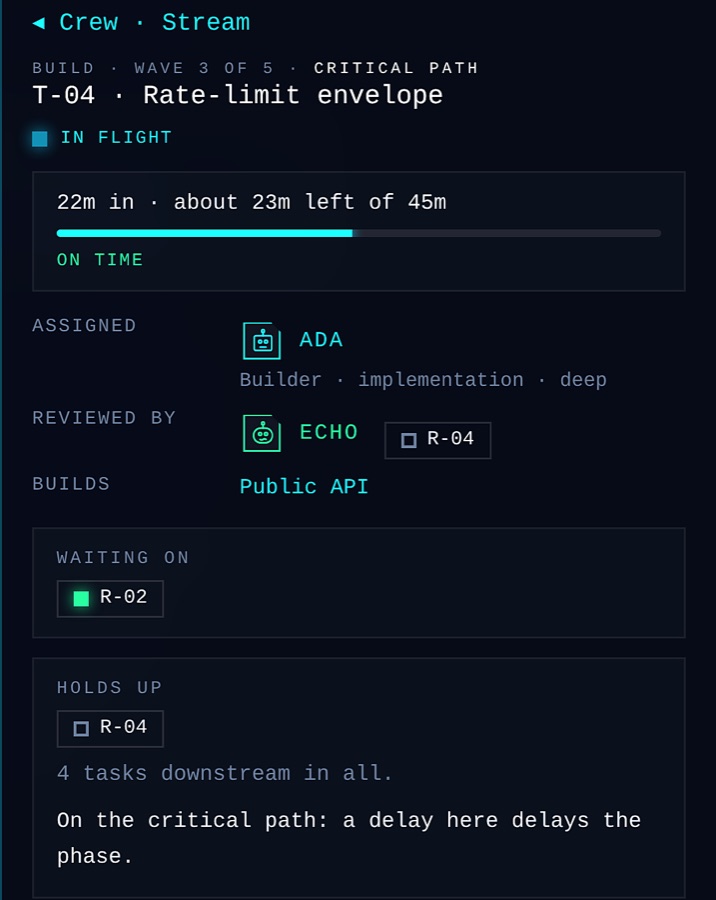
The live build shows the phase as waves of tasks, with the agent working on each one, what has passed its check, and what is waiting for a person. Open any task to see who is building it, who will check it, how long it has left, and what is waiting on it.
A record of every problem caught, and how
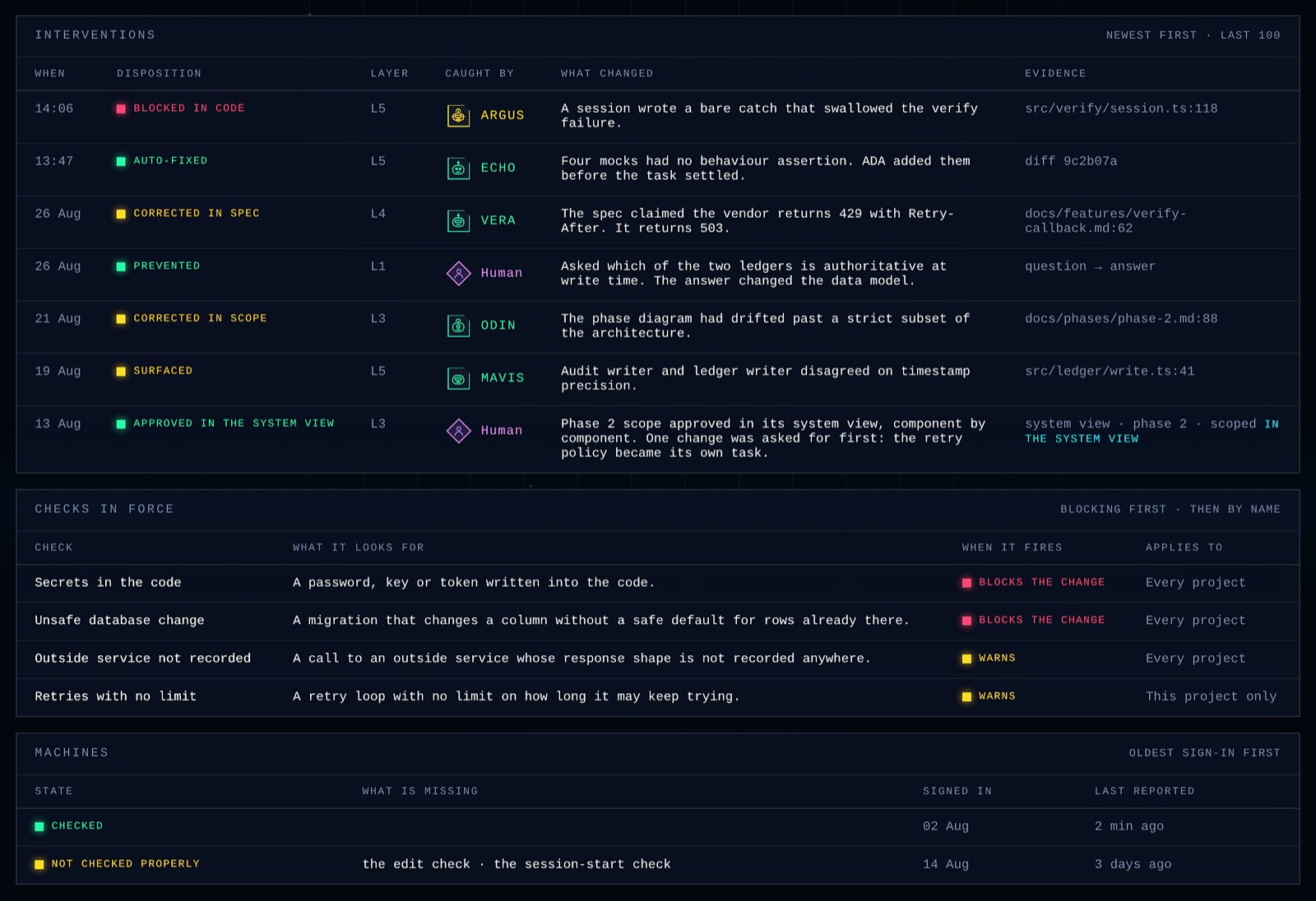
The ledger lists every time something was stopped or corrected: a change blocked in the code, a mistake fixed before the task closed, a claim in the plan corrected, a problem prevented by a question you answered. Each one says what changed, which agent or person caught it, and the file or answer that proves it. Below it are the checks in force on your project, what each looks for and whether it blocks or warns. The Phases page keeps each phase's dates, approvals, defects found in testing and outcome.
On your phone too
The console works fully on a phone, so you can see where a build has got to, and what is waiting for you, without being at your desk.
It carries on from the software you already have
Emergent can pull in an existing GitHub repository too. Halfcycle reads your existing code, tells you what it worked out and what it is unsure of, and plans the next piece of work from there.
When Emergent is the simpler choice
Halfcycle can have an app running today as well. The difference is that Emergent comes with hosting already there, while Halfcycle leaves the code with you, so going live is one more step, on hosting you choose, with Halfcycle guiding you through it. If you would rather not choose, Emergent is simpler. Halfcycle asks a few questions first, even for a quick prototype, and it runs inside Claude Code or OpenAI Codex, so you need that installed, even if you never write a line of code yourself.
Can you use both?
Yes. Use Emergent to get a first version running and in front of people. When it needs to become software you own and run where you choose, save it to GitHub, open it in Claude Code or Codex and carry on with Halfcycle, which plans moving off Emergent's hosting and database as a stage of its own.
Pricing
Halfcycle is free for solo developers, with the full process and every check. The agents run on your own Claude or OpenAI account, so the building itself is part of your normal usage. Details are on the install page.
Emergent has a free plan with 10 credits a month. Standard costs $20 a month ($17 a month billed yearly) with 100 credits, and Pro $200 a month ($167 billed yearly) with 750 credits; Business and Enterprise are priced on request. These are the prices on Emergent's pricing page on 30 October 2026. Prices and plans change, so check Emergent's website for the latest.
Questions people ask
Is Halfcycle an Emergent alternative?
Yes, when the software has to last. Emergent builds and hosts an app from your description with its own set of tools; Halfcycle runs a team of AI agents in your own Claude Code or OpenAI Codex that asks the questions first, writes the plan and designs, builds with whatever suits the project, reviews every piece with a separate agent and tests the finished app. If you want hosting and a database that come ready, with no choices to make, Emergent is the better fit.
Can I move an Emergent project to Halfcycle?
Yes. Save it to GitHub (on Emergent's paid plans), open the repository in Claude Code or Codex and run Halfcycle, which reads the code and plans from there. Moving the database and hosting off Emergent becomes a stage of its own in the plan.
Which is quicker for a first prototype?
Both can have an app running today. Emergent is a step shorter, because hosting and a database come ready. Halfcycle can be quick too. Tell it you want a quick prototype and it builds one, suggesting a database and hosting that take minutes to set up. After that it sizes each change for you, so a small fix goes straight through in one session, reviewed and tested, with no plan to approve.
Emergent has planning and testing agents too. What is different?
Emergent's interview and phased plan, and its testing agent that clicks through the app, are on its Pro plan and in beta. Halfcycle does that work on every new product and every larger change, and adds what Emergent does not describe: written documents you keep (a product spec, the architecture and a design for each part), a separate agent reviewing every piece of code before it is added, and what went wrong on other projects reaching yours automatically.
Do I need to know how to code to use Halfcycle?
No. You need Claude Code or OpenAI Codex installed and open, and Halfcycle does the rest in plain language. It works out the next step, asks you only the questions you can answer, gives a recommended answer for each, and points out the gaps you did not know to ask about, technical or not.
To use Halfcycle, do I need to know what to do next and tell it?
No. All you have to say is that you want to build something, and describe it in plain language. If you are not sure what to describe, it asks you for the details, one question at a time, with a recommended answer for each. It acts as the architect if you are not one, and as the analyst if you are not one, and its agents write the code, check it and test it for you. At each step it works out what comes next, so you do not have to.
Does Halfcycle learn from other projects?
Yes. When a software project goes wrong in a new way, what caused it and what fixed it are both kept, and both reach every other project automatically. So most of those problems never arrive on your project, and the ones that do come with the fix already known. What travels between projects is the shape of the problem, never your code or your documents, and we do not train on your work.
Is my code sent to Halfcycle?
Your code stays in your own folder and the agents run on your own Claude or OpenAI account. The checks read what they need and keep only what they found, not your material, and we do not train on your work.
Try it on your next project
Halfcycle is free for solo developers, gives you more control than an app builder, and builds for production from day one. Three steps:
-
Have Claude Code or OpenAI Codex
Either one, on your own account. You also need Node 18 or newer. Don't have an agent yet? Claude Code, OpenAI Codex.
-
Run one command in your project folder
npx halfcycleIt signs you in through your browser. Starting from nothing? Make an empty folder and run
git initin it first. On Windows PowerShell, typenpx.cmd halfcycle. -
Open the folder and say what you want to build
Claude Code: trust the folder when asked, choose to use the halfcycle server, then type what you want, in your own words.
Codex: trust the folder, type
/hooksand approve the Halfcycle entries, then type$halfcycle-setup.Halfcycle asks what it needs and tells you each next step.
Sources: Emergent pricing, home and enterprise pages, GitHub integration page and E3 announcement, checked 30 October 2026. Halfcycle details are from our own Hookbox build of 18 October 2026. If anything here about Emergent is out of date, tell us and we will correct it.
This comparison is written by Halfcycle and reflects our reading of Emergent's public website and documentation on 30 October 2026. Emergent changes its features and prices, so check emergent.sh for the latest before you decide. Emergent and Emergentlabs are trademarks of their owners and are used here only to identify their products. Halfcycle is not affiliated with, endorsed by or sponsored by Emergent or Emergentlabs.