Halfcycle vs Devin: the Devin alternative that costs a fraction and builds a whole phase at a time
Halfcycle does the engineering work Devin does, and the analyst, architect and tech lead work that comes before it: it plans, writes the tickets, builds with several agents at once, tests, reviews, and walks the running app. It does it inside the Claude Code or OpenAI Codex your developers already use, for one flat seat, which makes it many times cheaper: a month of agent work on the same Claude models costs five to twelve times less. And because the work runs through a guided workflow, one person can take a whole phase from plan to sign-off in one run, with the decisions made before the build rather than while it runs.
Devin, made by Cognition, is an autonomous AI software engineer that writes, runs and tests code on a cloud machine of its own and opens a pull request when it is done. Halfcycle is a Devin alternative for engineering teams: it works inside Claude Code or OpenAI Codex, asks the questions a ticket leaves out, has every piece of work reviewed by agents that did not write it, and leaves the code, the plan and the record in your own repository.
At a glance
| Feature | Devin | Halfcycle |
|---|---|---|
| Cost for a team | Teams: US$80 a month for the team, paid in as credits that every hour of agent work draws on, then more credits at API pricing. Pro (US$20) and Max (US$200) are for one person, with a quota | Many times cheaper: US$40 a seat a month, flat, and the agents run on the Claude or OpenAI seat you already pay for. Free for solo developers |
| What it is | An autonomous AI software engineer that works on its own machines | A full software team of AI agents, and the workflow that runs it, inside the coding agent your developers already use |
| How much in one run | One task per session; a Devin Bot can own an outcome and start a session for each piece | A whole phase: in our own build, 100 tasks from the approved plan to the signed phase in about 20 hours |
| Who plans the work | People, or a Devin Bot that plans from an outcome as it goes | Analyst, architect and coordinator agents, before any code: the spec, the architecture and the plan, written into your repository for a person to approve |
| Who writes the tickets | A person, or a Bot that starts a session for each piece | Halfcycle: it splits the plan into tasks and raises a ticket for each, in GitHub Issues or a file in your repository |
| When a person decides | Whenever a decision or a pull request lands in the Bot's Needs you list, while the work runs | Before the build, then at the end: the answers, the plan, the sign-off |
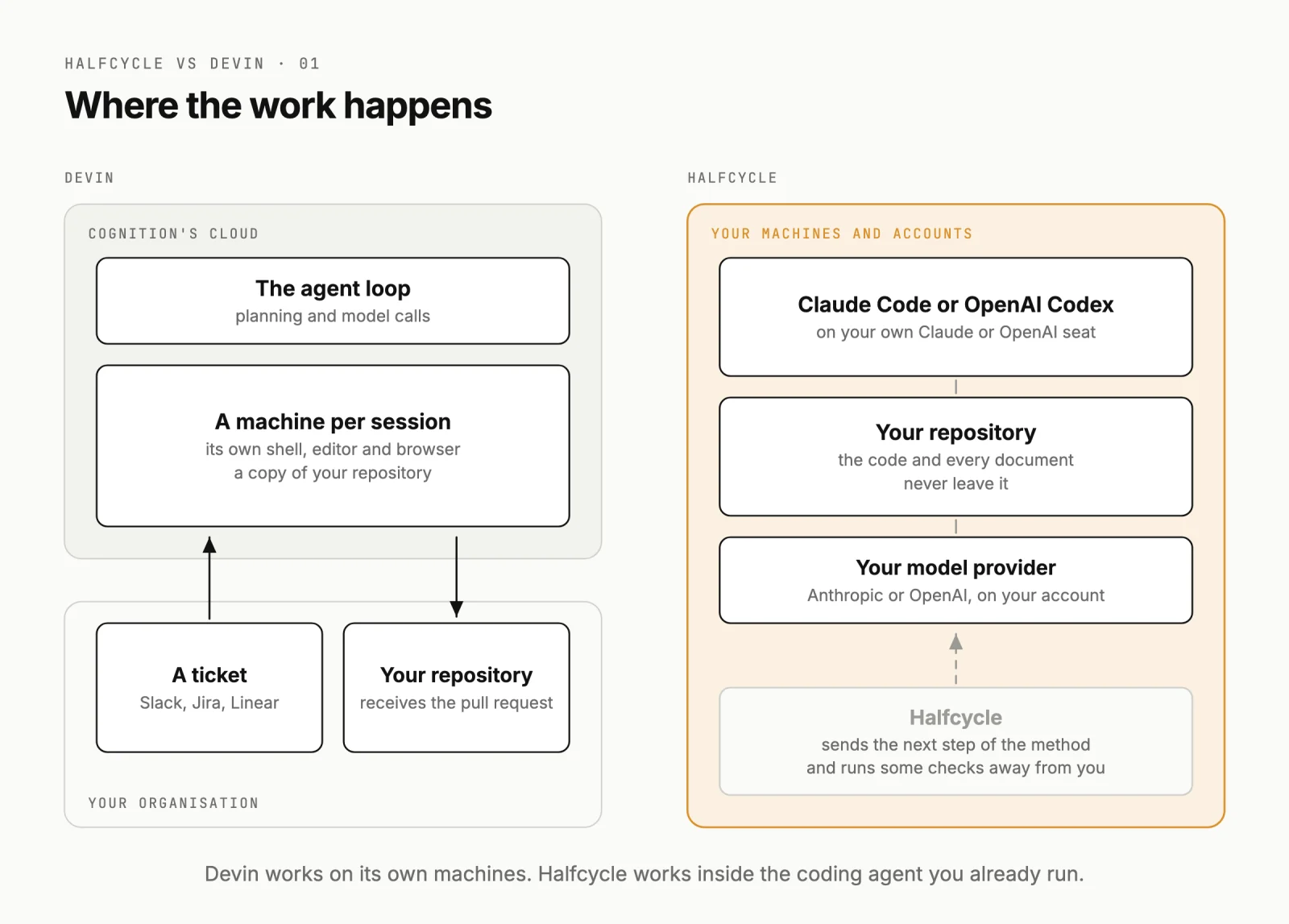
| Where the work runs | A cloud machine per session, with its own shell, editor and browser; the planning stays in Cognition's cloud | On your developers' machines, in Claude Code or OpenAI Codex, on your own model account |
| Where work starts | Slack, Linear, the web app, its desktop app, a CLI or an API; Jira and Microsoft Teams on Enterprise | In a Claude Code or Codex session, and in the Halfcycle console |
| Best size of task | In its own guidance, clear tasks of three hours or less | Any size: it sorts each request into a small change, a mini phase or a full phase, and says why |
| Before the code | Optional: Ask mode scopes a task without changing code | Questions one at a time, a written plan, and a person approves it before anything is built |
| Checking the work | It reviews its own output; Devin Review reviews the pull request; a person merges | Every task reviewed twice by agents that did not write it; tests run; an agent walks the live app; a person signs the phase |
| Learning | From your organisation: skills, playbooks and past sessions | From your organisation and from every other project: when any of them goes wrong in a new way, the cause and the fix reach yours |
Everything Devin does, Halfcycle does too
Go down Devin's list of what it does for an engineering team and Halfcycle has an answer for each, usually with one more step of checking or one less job for a person, and all of it at a fraction of the cost.
| Devin | Halfcycle |
|---|---|
| Writes the code, runs it and iterates until the tests pass | Builder agents write the code and run the tests; a tester agent checks that the tests test the right thing |
| Plans before coding, if you ask it to (Ask mode) | Plans on every full phase: the analyst asks the questions a ticket leaves out, one at a time, and the answers become a written plan a person approves |
| Runs several Devins in parallel, and a Devin Bot can own an outcome and plan it as it goes | Runs builders in parallel on separate copies of the code, ordered by what depends on what, across a whole phase planned and approved before the build |
| Reviews its own output, then Devin Review on the pull request | Has every task reviewed twice, by agents that did not write it, and sends it back until nothing is left |
| Tests the app in a browser and records the main flow, when testing is on | Walks each journey of the phase in the live app, with an agent that built none of it |
| Works on an existing codebase | Reads the code first and changes nothing, then rebuilds the plan from it with every claim pointing at a file and a line; a product spread over several repositories is one project |
| Learns your organisation: skills, playbooks, past sessions | Applies your organisation's own rules to every project, and brings the cause and the fix of what went wrong on every other project |
| Takes a ticket, or an outcome a Bot breaks into sessions | Does the planning first, with analyst, architect and coordinator agents, then writes the tickets itself, one per task, in GitHub Issues or a file in your repository |
| A web app, a desktop app and a CLI | Runs in Claude Code or OpenAI Codex, in the terminal or the editor, with a web console that shows the plan, the agents and the live build |
| SSO, roles and an audit log | Roles on Team; an audit log on Team and Enterprise; sign-in through your identity provider on Enterprise; a signed record of every phase |
Two answers to the same question
Every engineering organisation putting agents on its codebase is answering one question: where does the agent's judgement come from, and who is accountable for what it ships? Devin and Halfcycle answer it in opposite ways.
Devin's answer is a better engineer. Cognition builds the agent, the machine it works on and, increasingly, the model it thinks with: its own SWE-2 model sits beside frontier models from other labs, and its Fusion harness pairs a frontier model with a cheaper helper to cut cost. You give it a task and it comes back with a pull request.
Halfcycle's answer is a better team. It runs on the Claude Code or OpenAI Codex your developers already use, and it is a full software team of AI agents: an analyst that asks what the ticket did not say, an architect, builders, reviewers that did not write the code, a tester, and an agent that walks the live app. The method that directs them is served to each session one step at a time, so it improves without anybody updating anything.
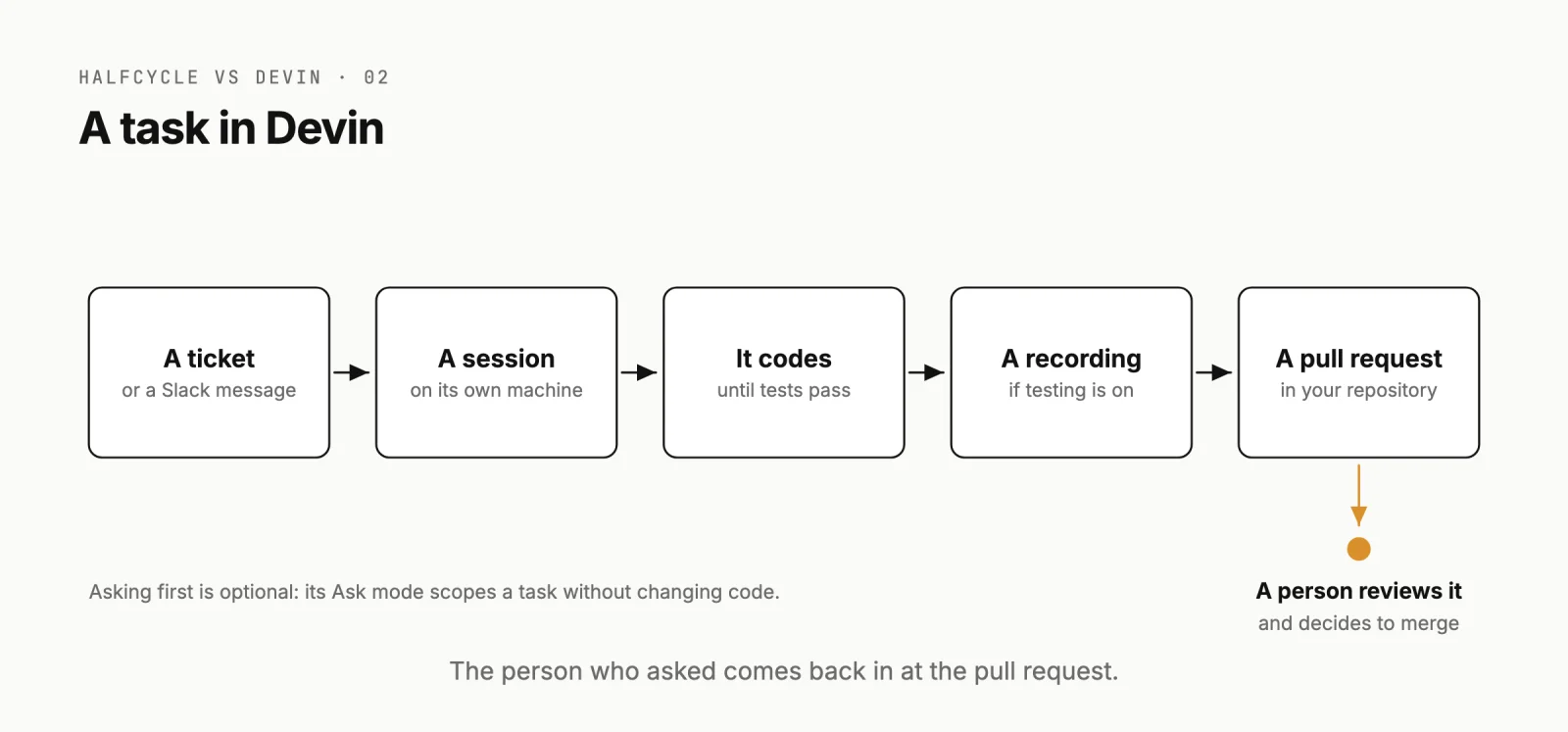
How a task moves through Devin
A task usually starts as a ticket in Linear or a mention in Slack, or in Jira or Microsoft Teams on Enterprise. Devin opens a session on its own machine, clones the repository, writes the change and iterates until the tests, lint and type checks pass. Since Devin 2.2 it reviews its own output before opening the pull request. If testing is switched on, it drives the app in a browser and sends a screen recording of the main flow. Then it opens a pull request that follows your team's conventions, and a person reviews it and decides whether to merge.
Planning first is available but optional. Devin's Ask mode explores the codebase and drafts a prompt without changing code, and its docs recommend starting there unless the plan is already fully scoped. A coordinator session can also run several Devins in parallel, each on its own machine, for work that fans out, such as a migration across many services.
For bigger work, Devin Bots arrived in November 2026. You give a Bot an outcome to own rather than a task; it plans the work, starts a Devin session for each piece, follows them up and collects what needs a person (decisions, pull requests to review or merge, requests for more access) in a list called Needs you. A Bot's usage is its chat plus every session it starts.
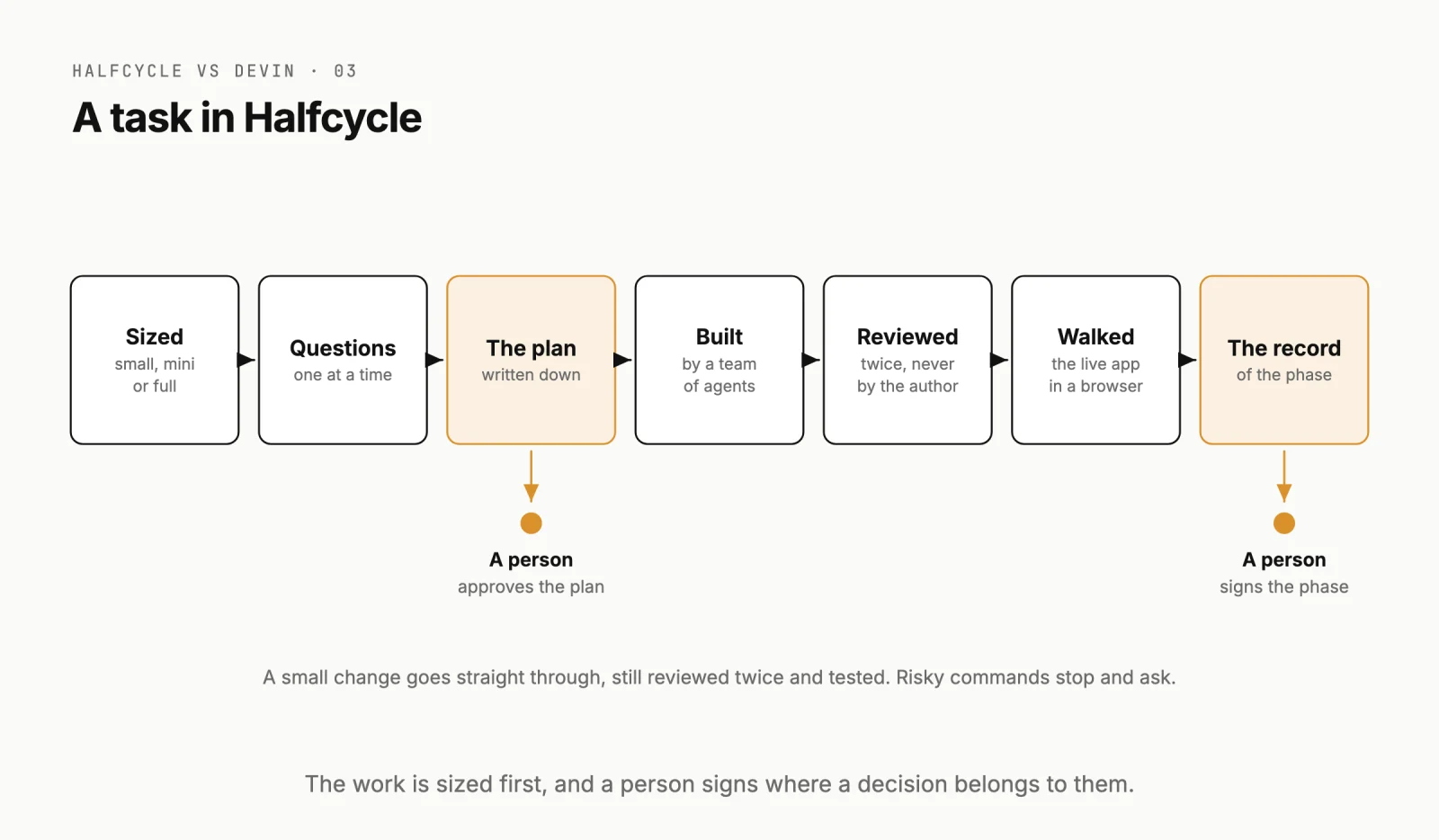
How a task moves through Halfcycle
A request starts in a Claude Code or Codex session. Before anything is built, Halfcycle looks at which parts of the system the request touches and sorts it: a small change goes straight through, a change that reaches across parts gets a short plan to approve, and anything bigger gets the full team. It says which path it chose and why, and if a small change turns out bigger than it looked, it moves itself up and tells you.
On the full path, the analyst asks the questions a ticket leaves out, one at a time, with a recommended answer and the reason for it. The answers become a plan in your repository: the product spec, the architecture, the phases and a design for each component. A person approves it. Then the lead agents split it into tasks, builders work on separate copies of the code, every task is reviewed twice by agents that did not write it, the tests are checked, and at the end of the phase an agent that built none of it opens the live app and walks each journey the phase was for. A person signs the phase, and the record is frozen.
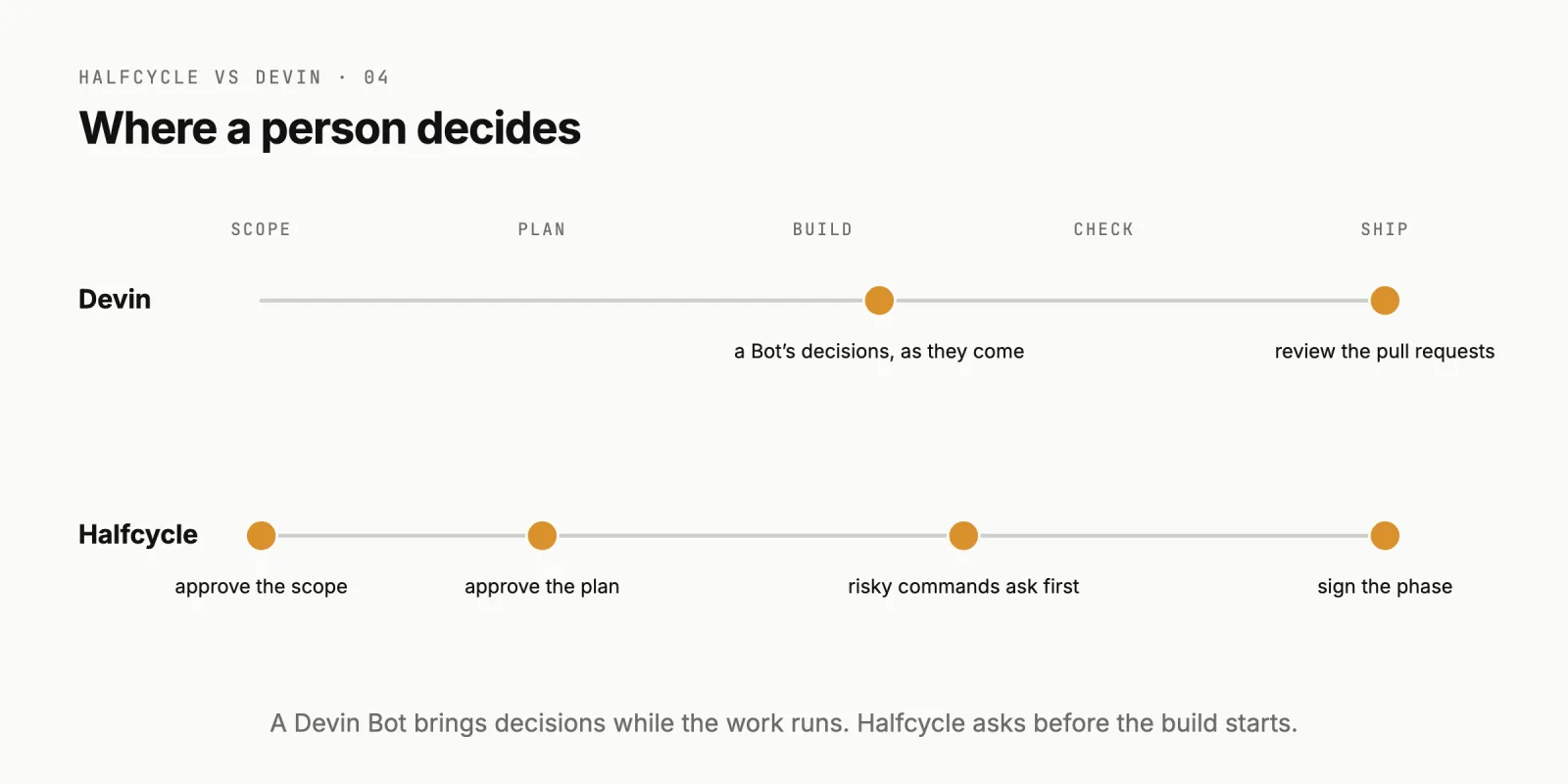
Where a person signs
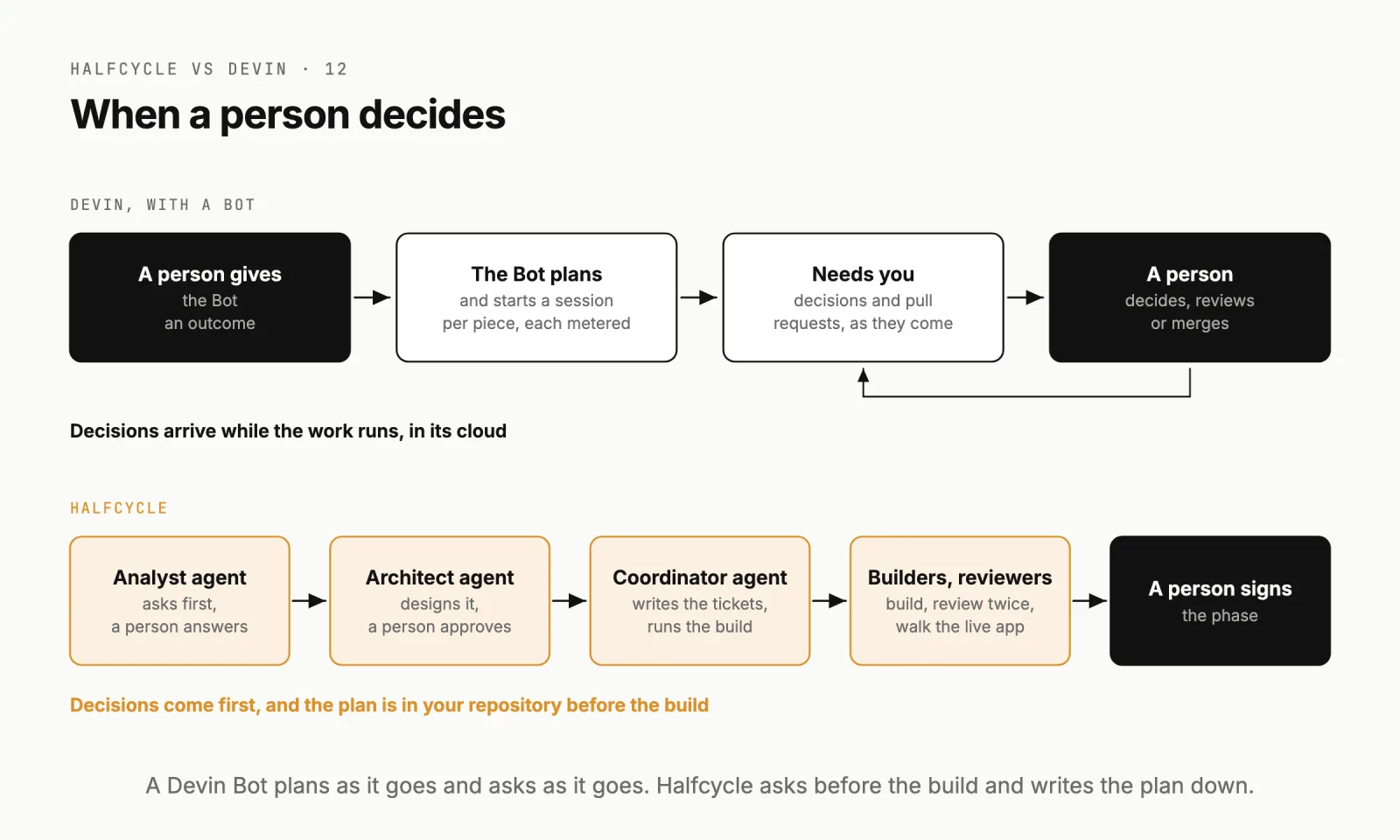
This is the difference engineering leads tend to feel first. In Devin, the person meets the work as it happens. A session ends in a pull request, and the reviewer works out from the diff what was decided along the way. A Bot brings decisions to its Needs you list while the work runs, with the option it recommends marked, and the pull requests come back for review. Either way, the decisions arrive during the build, after the work has started in some direction.
Halfcycle puts the person at the decisions that are theirs. They approve the scope and the plan before any code is written, which is when a wrong assumption is cheapest to fix. Risky commands, such as deleting unsaved work, rewriting history, reading credentials, publishing or deploying, stop and ask in plain words before they run. And the phase closes only when a named person signs it, with the record of what was decided, built and checked in front of them. No agent can approve a scope or close a phase.
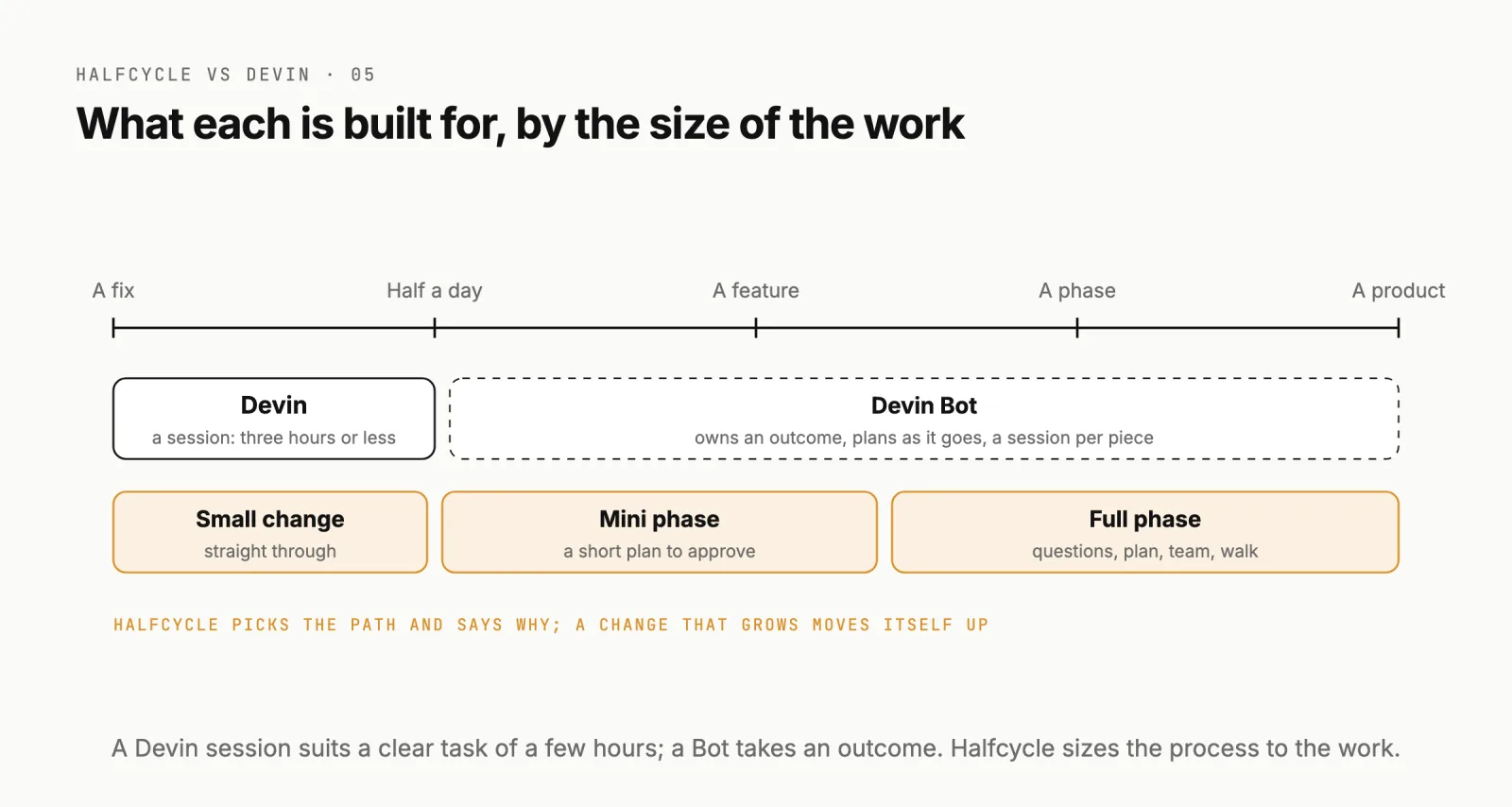
The size of the work
Cognition is candid about where Devin is strongest. Its guidance says that if a task would take you three hours or less, Devin can most likely do it, and to keep sessions small. Its own review of 2025 says Devin cannot independently tackle an ambiguous coding project end to end, performs worse when it is told more after starting, and does best with clear requirements and outcomes it can verify. That is an honest description of an excellent ticket-taker, and a lot of engineering work is exactly that: migrations, upgrades, small fixes, test coverage, work a team has already decided on. Devin Bots are Cognition's answer for the bigger end: a Bot owns an outcome and runs as many sessions as it takes, planning as it goes.
Halfcycle is built for the other end as well. The questions, the plan, the phases and the live walk exist because most of what goes wrong in a bigger piece of work is decided before the first line of code, in the parts nobody wrote down. So Halfcycle settles those parts before the build, in writing, rather than as they come up. It sizes that process to the change, so a one-line fix does not sit through a planning session, and a new service does not ship on a ticket's worth of thought.
A whole phase in one run
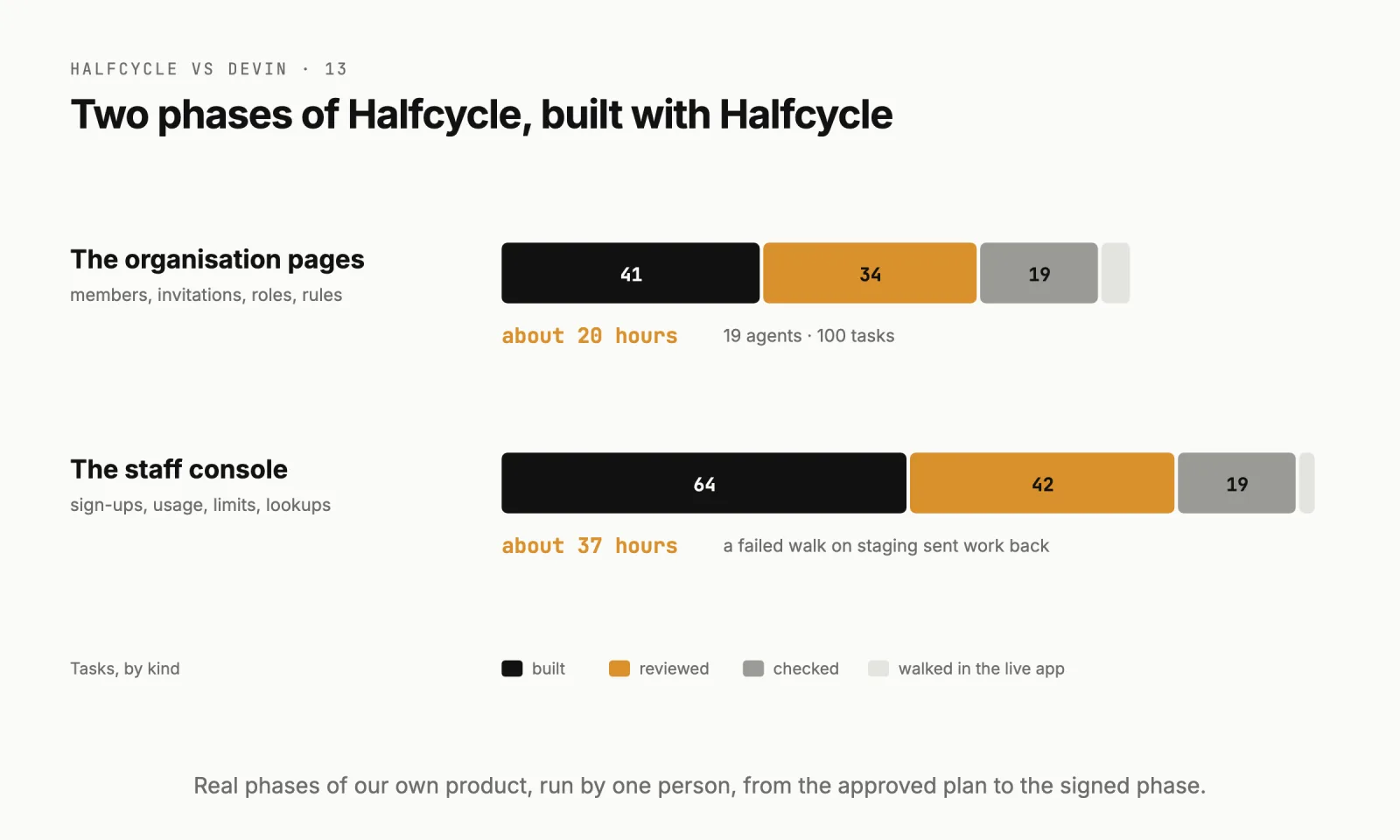
We build Halfcycle with Halfcycle, so our own records show what one run takes on. The organisation pages (members, invitations, roles and the rules an admin sets) were one phase: 100 tasks, of which 41 were building, 34 were reviews, 19 were checks and 5 were walks through the live app, shared between 19 agents. From the approved plan to the signed phase took about 20 hours on the clock, overnight included, and one person ran it.
The staff console we run the service from was bigger: 128 tasks in about 37 hours, with the specs written inside the phase. Its first walk on our staging site failed, and the walker's report went back to the team as a round of fixes before the phase could close. That is the part a ticket queue does not do for you.
Devin can take on work of this size too, through a Bot. The difference is in how the run starts and what it costs. In Halfcycle the questions come first, and the plan is written into your repository and approved before a line is built; a Bot plans as it goes and brings decisions to a person while the work runs. And every session a Bot starts counts towards Devin usage, while a phase in Halfcycle runs on a flat seat and the Claude or OpenAI seat you already have.
How many people it takes
A Devin session takes a ticket, and everything before the ticket is a job for people: an analyst works out what is needed, an architect decides how it fits the system, and a tech lead turns that into a plan. A Devin Bot takes on more of it: it plans from an outcome and starts the sessions itself. What a Bot does not do is settle the open questions before it starts: it brings them to a person as they come up, while sessions are already running, and there is no written specification or architecture for anyone to approve first.
Halfcycle does those jobs too. Its analyst agent asks the questions and writes the product spec; its architect agent writes the architecture and a design for each component; its coordinator agent turns the approved plan into tasks, raises a ticket for each, and runs the build from end to end. Builders, reviewers and a walker do the rest, and the console shows every one of those agents at work. The documents those roles would have written are in your repository when it is done. The person is there for the three decisions that are theirs: the answers to the questions, the plan, and the sign-off, with risky commands stopping to ask in between. Because the answers come before the build, the agents build from decisions a person has already made, not from guesses that a person corrects later. And however many agents a phase runs, the price from Halfcycle stays one flat seat, which is why the same work costs many times less than on a Bot that pays for every session it starts.
A worked example: the ticket that looked like three hours
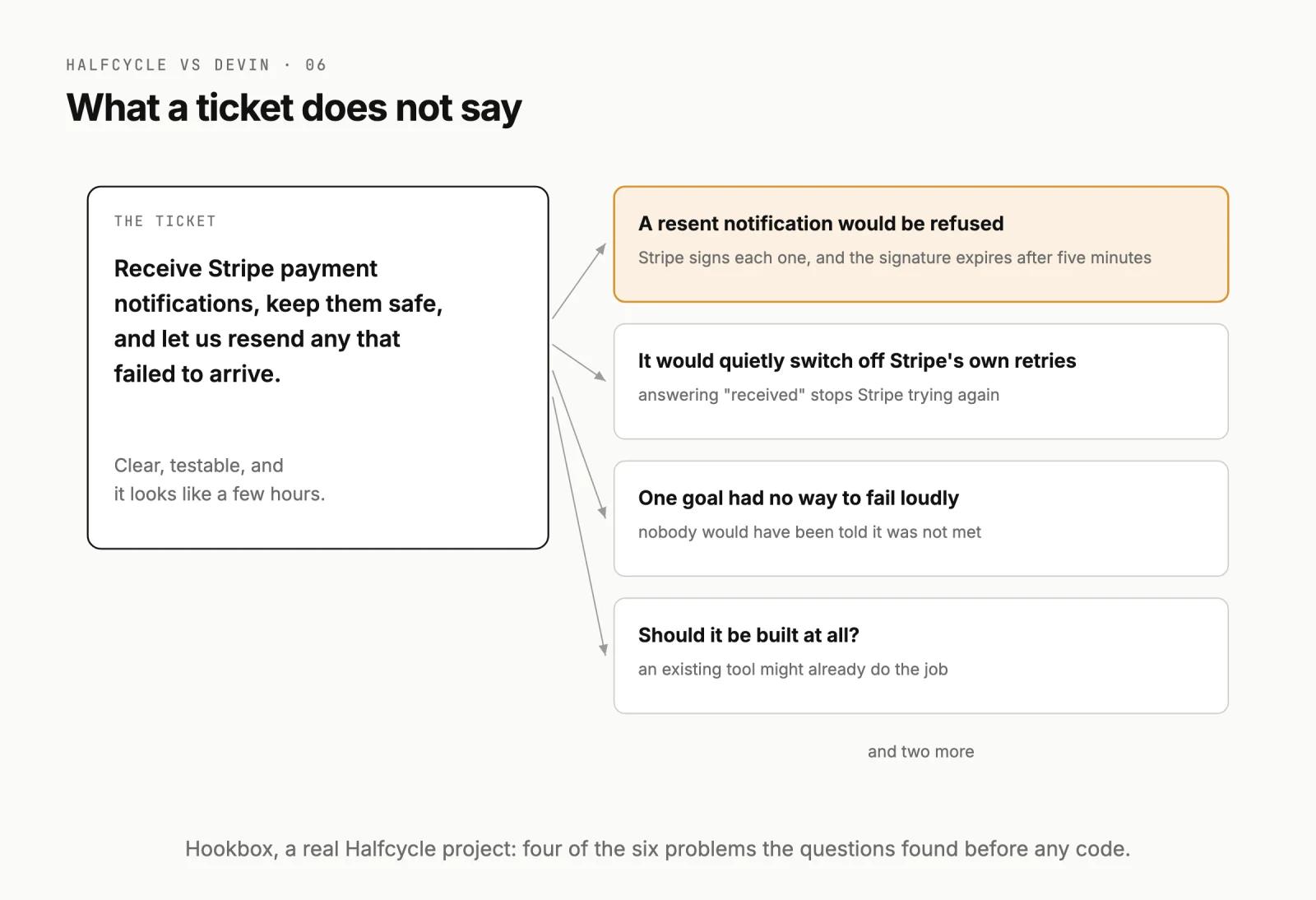
Here is a real project we built with Halfcycle, Hookbox: a small service that receives payment notifications from Stripe and keeps them safe, so none are lost if the system that should handle them is down. Written as a ticket, it reads like the kind of task an autonomous agent would take on:
HB-1  Receive Stripe payment notifications, keep them safe,
      and let us resend any that failed to arrive.

Acceptance
  - Every notification Stripe sends is stored
  - A failed one can be resent from a list
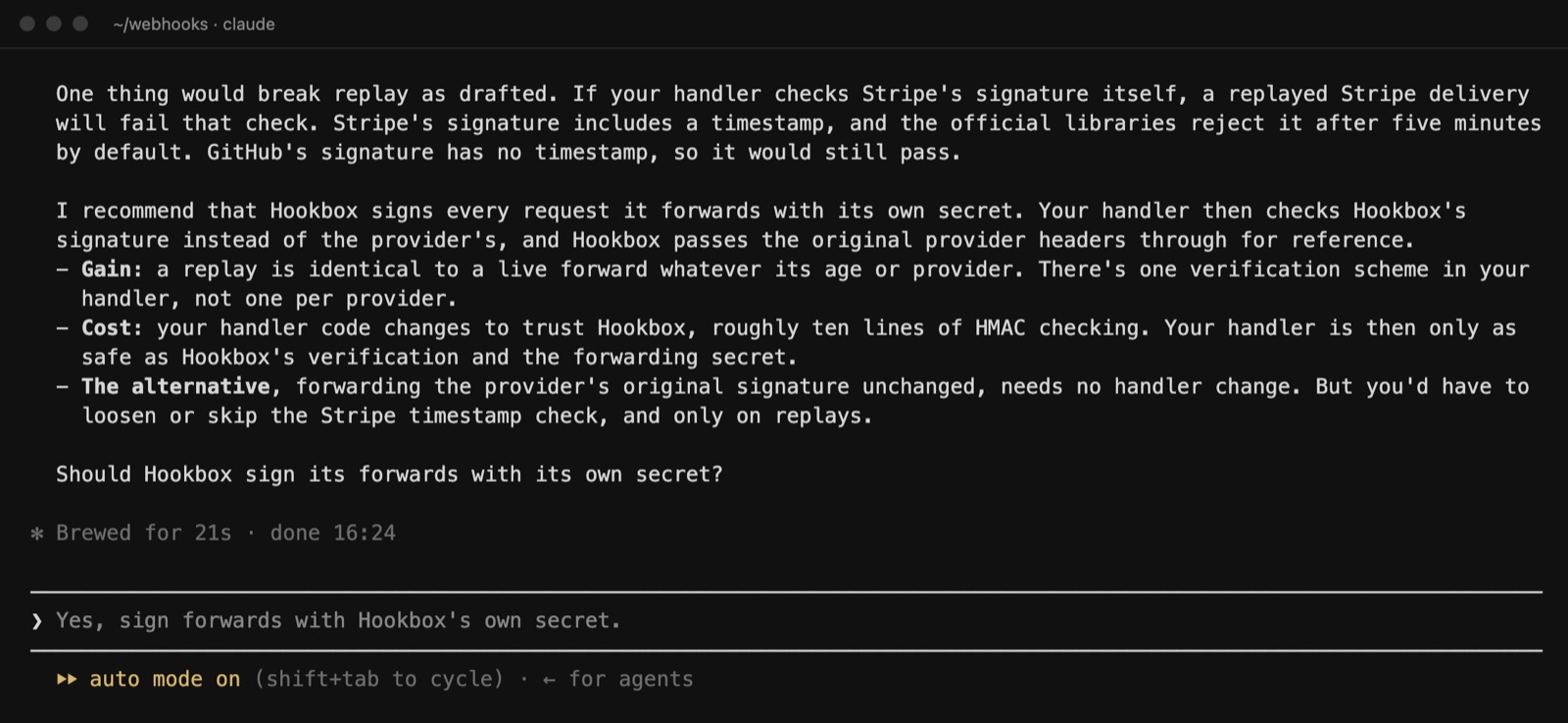
- Tests passHalfcycle's questions found six problems in it before a line of code was written. The one that matters most: Stripe signs each notification, and the signature expires after five minutes. A notification resent later would be rejected by the receiving system as a fake. The ticket's second acceptance line could pass every test and still fail on the first real resend. Halfcycle explained what each fix would cost and recommended one: Hookbox signs what it forwards with its own key. Fixing it cost one sentence in the plan.
The others included that answering "received" to Stripe quietly switches off Stripe's own retries, a goal that had no way to fail loudly, and whether to build the thing at all rather than use an existing tool. None of them is visible in the ticket, and none is the kind of thing tests catch, because the tests are written from the same ticket.
We have not run this ticket through Devin, and we are not claiming what it would do. Devin's Ask mode could surface some of this if a person thought to ask. The point is where the asking sits: in Halfcycle it is a step every full phase goes through, with the answers written into the plan a person approves; in Devin it is optional, and the first required human look is the pull request.
What it costs
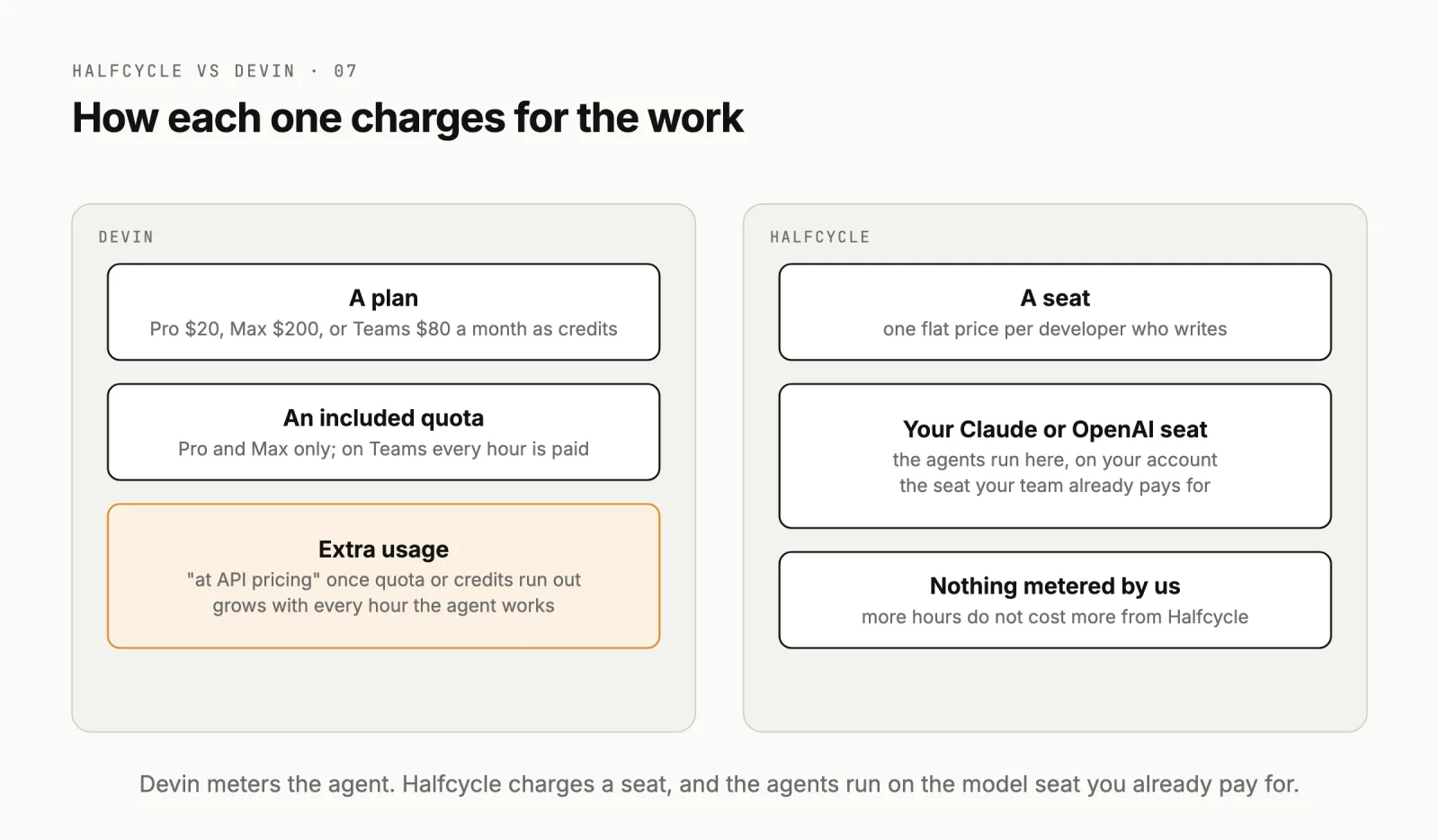
The two products charge in different ways, and the difference grows with use. Devin's plan for a team, Teams, is US$80 a month for the whole team, paid in as credits; there is no allowance per member, so every hour of agent work draws on those credits, and once they are gone more are bought at API pricing. Pro (US$20) and Max (US$200) are for one person and come with a quota, and Devin says most users never use it up. Enterprise customers are billed in Agent Compute Units at a rate set in their contract. On every plan a team can use, the more hours the agent works, the more the month costs.
Halfcycle charges a flat seat for each developer who writes, and the agents run on the Claude or OpenAI seat your team already pays for. Halfcycle meters nothing: hour 160 costs the same from us as hour one. That is the whole reason Halfcycle is so much cheaper, and the more your team uses agents, the bigger the gap gets.
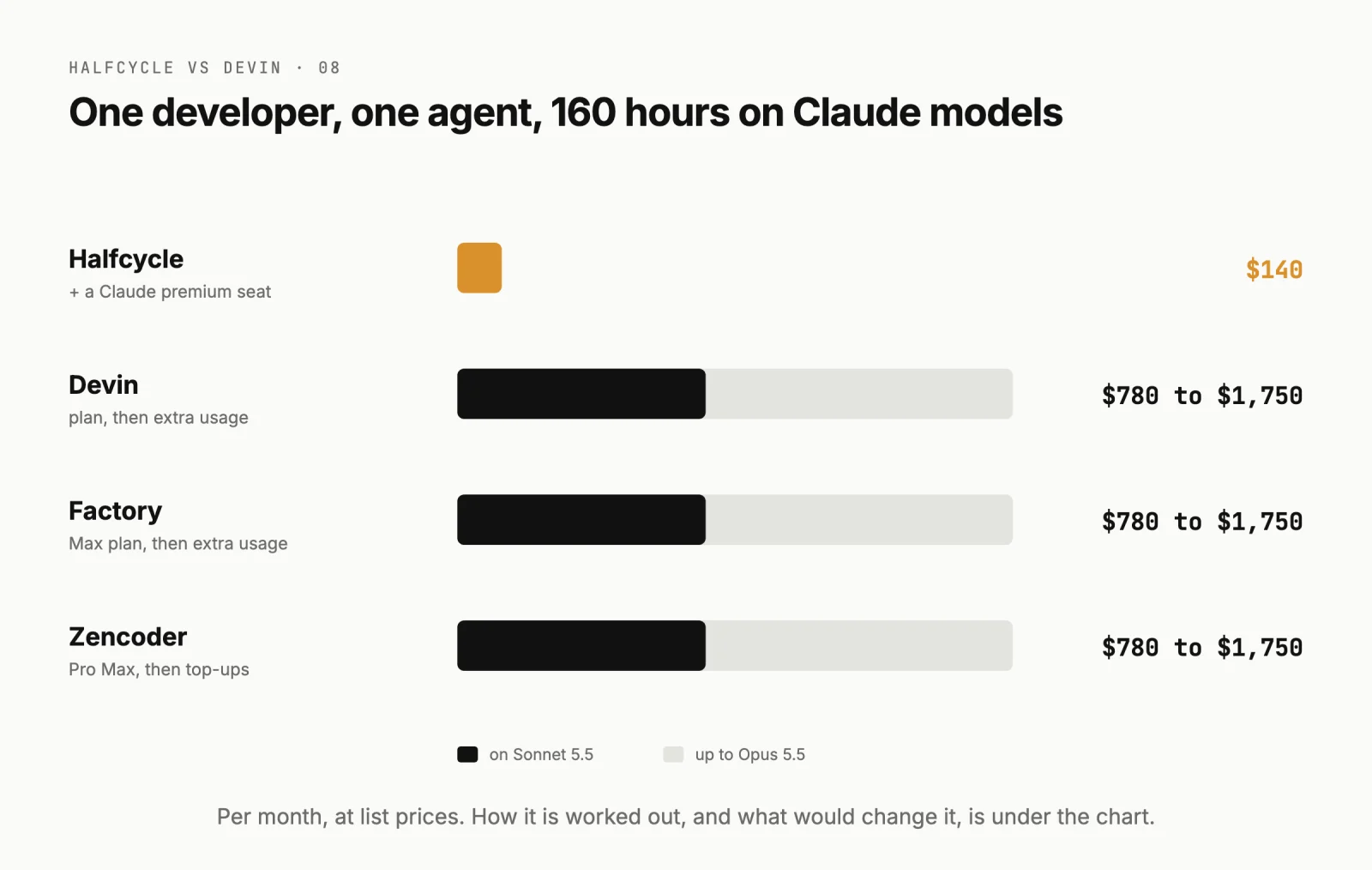
To put numbers on it, take one developer with one agent working a full working month, 160 hours, on Claude models. Devin publishes no per-hour price, so we priced the hours with the most recent public measurement of what Claude Code work costs at list prices: TeamoRouter's median of US$4.89 an hour on Sonnet 5.5 and US$10.93 an hour on Opus 5.5, measured on real sessions from 6 October to 2 November 2026.
How the chart is worked out
- Halfcycle, US$140. The Halfcycle seat at US$40 a month, plus a Claude Team premium seat at US$100 a month on annual billing, which includes Claude Code. This assumes the month's work fits within the premium seat's usage limits. Anthropic does not publish those limits in hours, and beyond them it sells extra usage, so a heavy month can cost more on the Claude side. It never costs more on ours.
- Devin, US$780 to US$1,750. 160 hours at US$4.89 to US$10.93 an hour on the Teams plan, where the month's US$80 is paid in as credits that the first hours use up, and every hour after that is bought at API pricing. A lighter month on the one-person Max plan may stay inside its quota at US$200; Devin does not publish the size of that quota.
- What would bring Devin's figure down. Devin's own SWE-2 model, which runs at no cost on its paid plans (two sessions at a time for each member on Teams), and which Cognition says is much cheaper to run than frontier models. If SWE-2 does your work well, the gap narrows a long way. A ChatGPT plan can also pay for GPT model usage. The chart compares like with like: the same Claude models on both.
- Factory and Zencoder are priced the same way, a plan and then usage at model rates, using Factory's and Zencoder's pricing pages on 19 November 2026.
- These are list prices, not what any one team pays. The measurement counts sessions of ten minutes or more, and a busy hour can cost two or three times the median. Real months vary; the shape does not, because one line is a meter and the other is flat.
Who checks the work
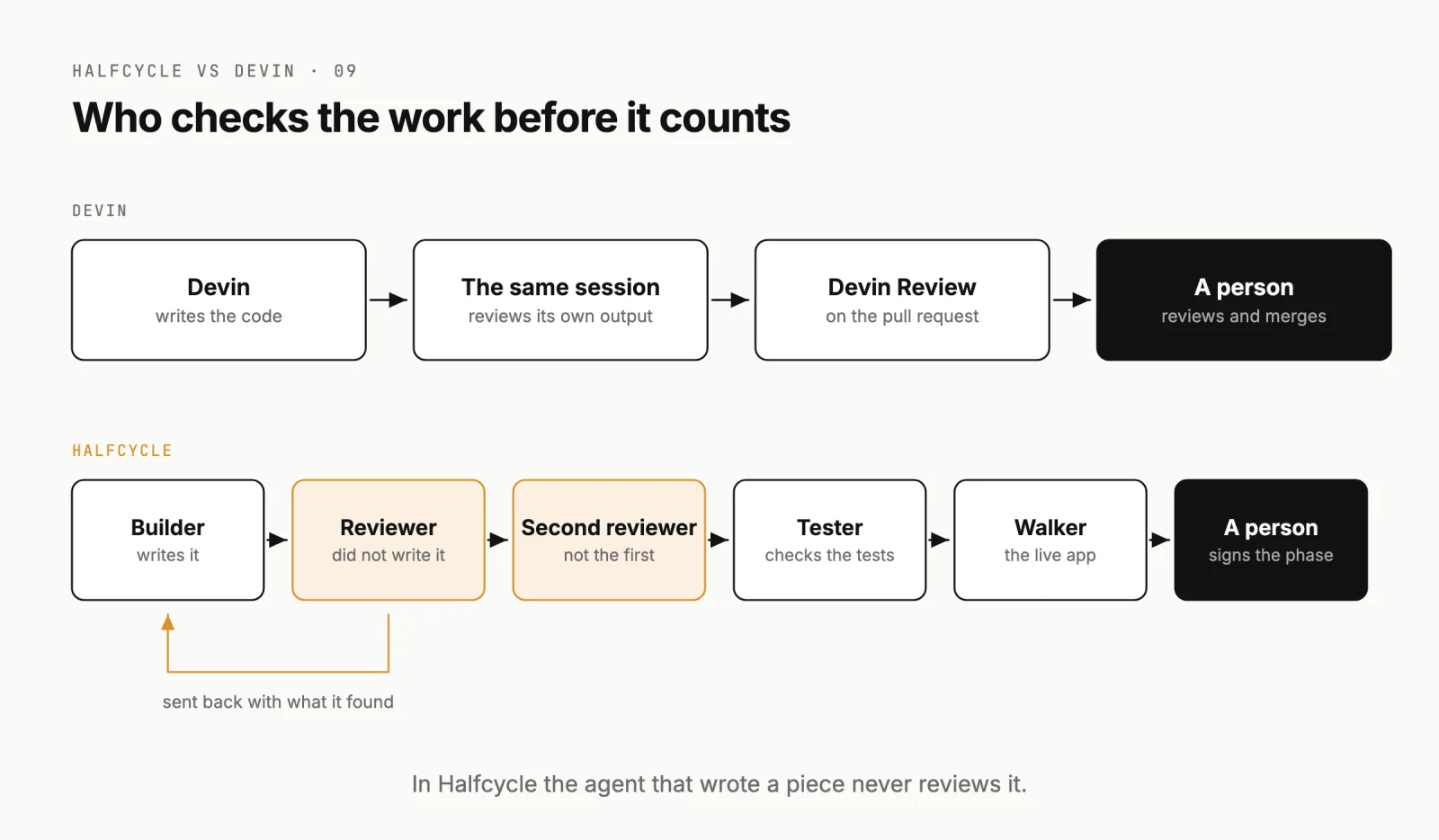
Devin checks its own work and then has it checked again. The session that wrote the change reviews its output before the pull request, and Devin Review, Cognition's review product, can review pull requests on GitHub, GitLab, Azure DevOps and Bitbucket, including the ones Devin opens. For the running app, Devin can record itself clicking through the main flow, and Cognition's own docs say that for more exhaustive coverage you should use your existing test suites and CI.
In Halfcycle, the agent that wrote a piece of work never reviews it. Each task goes to a reviewer that did not write it, then to a second reviewer that is not the first, and anything they find goes back to the builder with what was wrong. A tester checks the tests. At the end of the phase, an agent that built none of it signs in to the live app and walks each journey the phase was for, and what it finds goes back to the team until nothing is left in the way. Checks on written code also run after every edit, and the person editing cannot switch them off. All of that checking is included in the one flat seat, so more reviews never make the month more expensive.
Where the lessons come from
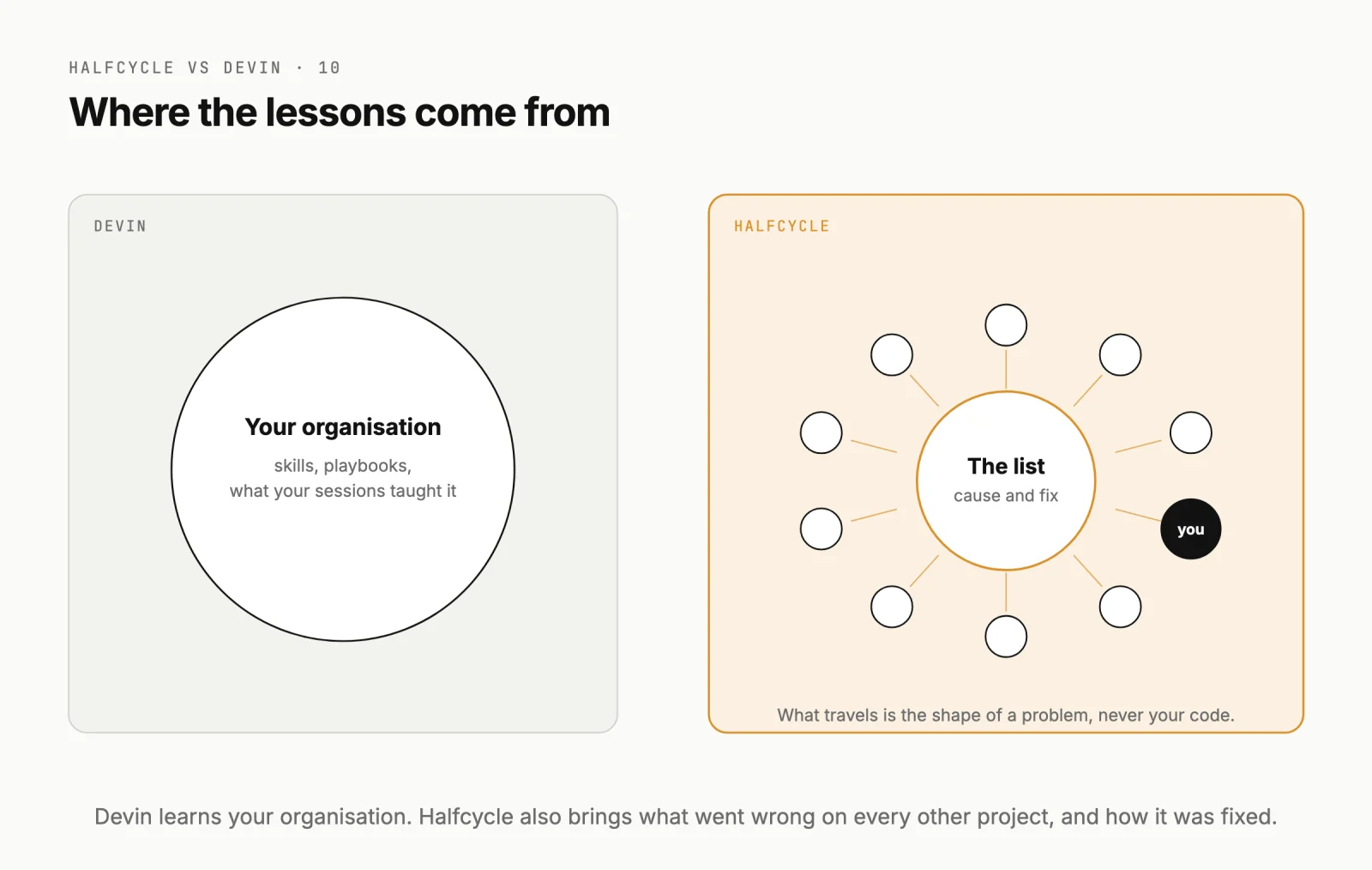
Devin learns your organisation. Its knowledge, now moving to skills, is generated from your READMEs and agent instructions; playbooks keep prompts that worked; session insights look back over past runs. Over time it gets better at your codebase and your conventions.
Halfcycle learns your organisation too: an admin can write a convention, a check or a step that applies to every project from the next edit. It also brings something from outside. When any project that Halfcycle runs on goes wrong in a new way, what caused it and what fixed it are both kept, and both reach every other project automatically. For your team that means two things: most of the problems other projects have already hit never arrive on yours, and the ones that do arrive come with the fix already known. The list grows with every project, not only the ones you run.
What travels between projects is the shape of a problem, with counts and timings, never your code or your documents, and we do not train on anyone's work.
Data, security and proof
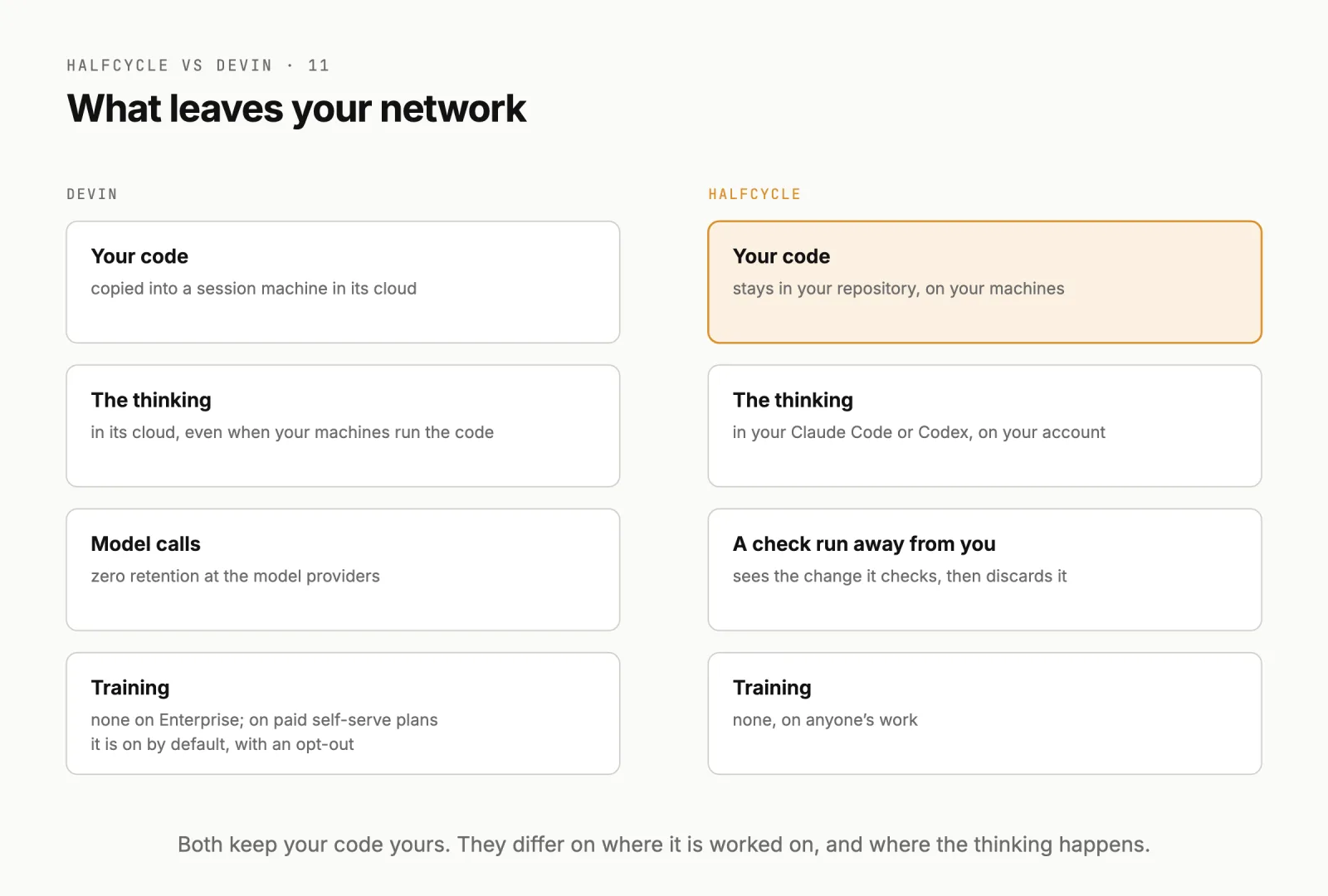
Devin's enterprise story is strong, and it deserves to be stated plainly. Cognition holds SOC 2 Type II and ISO 27001, with FedRAMP High in progress. It offers SAML and OIDC sign-in, SCIM, custom roles, an audit log of every session and action, single-tenant deployment in its own cloud, customer-managed keys, and an air-gapped desktop and CLI for federal customers. Model providers keep nothing.
Two details are worth reading closely. First, with Devin the planning and model calls run in Cognition's cloud on every option, including Outposts, which runs the execution on your own machines. Second, on training, Cognition's enterprise page says it does not train on your code, while its security docs say that on paid self-serve plans your data may be used for training by default, with an opt-out, and Enterprise needs your written consent. If you are on a self-serve plan, check that setting.
With Halfcycle, your code stays in your repositories on your machines, and the agents run inside your own Claude Code or Codex on your own account, so the model calls go from your machine to Anthropic or OpenAI. Halfcycle holds no access to your repositories and never holds or proxies your model credential. Some checks run away from your machine so they cannot quietly agree with the session that did the work; such a check sees the change it is checking, returns its finding and keeps nothing. We do not train on your code, your documents or your conversations with the agents.
What Halfcycle gives an auditor is evidence: each phase closes with a record of what was planned, built, checked and carried over, every decision with the options turned down, and who approved what, by name. It is frozen when the phase closes and cannot be edited afterwards by anybody, including us. On Team and Enterprise an audit log records who invited whom, who changed a rule and who signed each phase; on Enterprise, members sign in through your own identity provider.
Neither product replaces your security work. Halfcycle does no dependency or vulnerability scanning, no threat modelling, no penetration testing, no static or dynamic analysis and no load testing. Keep doing all of it. Cognition sells separate security products, which are outside this comparison.
How to judge an AI engineering tool for your team
Nine questions to put to any tool in this category, Devin and Halfcycle included. The middle column is what a good answer looks like for most engineering organisations; weigh them for yours.
| Question | A good answer | Devin | Halfcycle |
|---|---|---|---|
| Does it run where your code already lives? | Fewer new places that hold a copy of your code | Its own cloud machines; an option runs execution on yours | Yes: your machines, your agent, your account |
| Who decides what gets built? | A person approves scope before code, not only after | At the pull request | Scope, plan and phase, by name |
| Does the process fit the size of the change? | Small changes stay small; big ones get a plan | Sized for tasks of three hours or less | Sized per request, and moved up if it grows |
| How much can it take on in one go? | A whole piece of planned work, not one ticket at a time | One task per session, or an outcome handed to a Bot | A phase: tens of tasks, planned, built, reviewed and walked |
| When are your people needed? | Before the build, when a wrong assumption is cheapest to fix | As decisions and pull requests come up during the work | Before the build and at the sign-off |
| Does the author check its own work? | Reviewers that did not write the code | Self-review, then Devin Review on the pull request | Two reviews, neither by the author |
| Is the running app tested? | Something clicks through the product, not only unit tests | A recorded test of the main flow, on request | An agent walks each journey of the phase in the live app |
| What does an extra hour cost? | A cost that does not rise with every hour of agent work | Extra usage at API pricing once the quota is used | Nothing more from Halfcycle |
| Where do its lessons come from? | Lessons from beyond your own team | Your organisation | Your organisation and every other project |
| Is there a record an auditor can read? | Decisions, checks and approvals, frozen when done | An audit log of sessions and actions | A record per phase, plus an audit log |
| Can your team start without changing tools? | No new editor or agent to adopt | A new agent, plus its desktop app if you want it | Inside Claude Code or OpenAI Codex |
Where Devin is the better choice
If most of your agent work is a queue of well-defined tickets, migrations, upgrades, small fixes and test coverage, and you want them picked up from Slack or Linear (or Jira and Microsoft Teams on Enterprise) and worked on in the background while your engineers do something else, Devin is built for exactly that, and it does it well. Parallel sessions on separate machines suit large fan-out work such as a migration across hundreds of files. Its machines also run Windows, macOS and Android, which matters for some teams.
If your procurement requires a certificate, Devin has SOC 2 and ISO 27001. If you want one vendor for the agent, the editor and the model, Devin offers all three. And Cognition is a much larger company than we are, which matters to some buyers.
Can you use both?
Yes, for different work. A team can run its planned product work through Halfcycle, where the questions, the plan and the reviews earn their keep, and send a queue of small, well-specified tickets to Devin. Devin's docs describe handing tasks to it from Claude Code or Codex, and Devin Review reviews pull requests whoever opened them. We have not tested a combined setup ourselves, so treat this as a shape to try, not a recipe.
Questions people ask
Is Halfcycle a Devin alternative?
Yes, and a much cheaper one, for teams that want their engineers to stay on the coding agent they already use. Devin is an AI engineer you hand tickets to, working on its own machines and billed as it works. Halfcycle runs a team of agents inside Claude Code or OpenAI Codex on your developers' machines, plans and checks the work the way a software team would, and charges one flat seat. If you want an agent that picks up tickets from Slack or Jira in the background, Devin fits that better.
Is Halfcycle cheaper than Devin?
Yes, for the same hours of agent work on the same Claude models: a full month of one agent's work costs five to twelve times less, by the working on this page. Halfcycle charges a flat seat and the agents run on the Claude or OpenAI seat your team already pays for, so more hours do not cost more from us. On Devin's Teams plan every hour of agent work is paid from credits, at API pricing once the month's US$80 is used. Devin's own SWE-2 model runs at no cost on its paid plans, which narrows the gap if that model suits your work.
Can Halfcycle do what Devin does?
The engineering work, yes: it plans, writes code, runs several agents in parallel, runs the tests, reviews the work, tests the running app in a browser, works on existing codebases and learns your organisation's rules. The table on this page goes through each one, and it does the analyst, architect and tech lead work that comes before the tickets as well.
How much work can Halfcycle do in one go?
A whole phase. In our own build, one phase of 100 tasks (41 built, 34 reviews, 19 checks and 5 walks of the live app) went from the approved plan to the signed phase in about 20 hours, run by one person. Devin's guidance for a single session is a clear task of three hours or less; its Bots can own bigger outcomes, with every session they start metered.
How many people does it take to run Halfcycle?
One person can run a phase. Halfcycle's analyst, architect and coordinator agents do the work an analyst, an architect and a tech lead would do before a ticket exists: the spec, the architecture, the plan and then the tickets. The person answers the questions, approves the plan and signs the phase. Devin Bots also plan and start sessions on their own; the difference is that a Bot brings decisions and pull requests to a person while the work runs, and every session it starts is metered.
Does Halfcycle work with Jira, Linear or Slack like Devin does?
Not in the way Devin does. Devin starts work from a mention in Slack or a Linear ticket, and from Jira or Microsoft Teams on Enterprise. Halfcycle starts in a Claude Code or Codex session and the console, because its first step is asking the questions a ticket leaves out, and it then raises the tickets itself. If background work from a ticket queue is what you need most, Devin fits that part better.
Can Halfcycle work on our existing codebase?
Yes. It reads the code and any planning documents, tells you what it worked out and what it is unsure of, and plans the next piece of work from where the project stands. Devin works on existing codebases too.
What does Halfcycle give an auditor?
A frozen record of each phase: what was decided, built, checked and approved, and by whom. Your code stays on your machines, and we do not train on anyone's work.
Do I need to change coding agents?
No. Halfcycle runs inside Claude Code or OpenAI Codex, on the accounts your developers already have. Devin is its own agent, with its own desktop app (formerly Windsurf) and CLI.
Try it on your team's next piece of work
Halfcycle runs inside Claude Code or OpenAI Codex, is free for solo developers, and is one flat seat for a team, many times cheaper than an agent billed for every hour it works. Three steps:
-
Have Claude Code or OpenAI Codex
Either one, on your own account. You also need Node 18 or newer. Don't have an agent yet? Claude Code, OpenAI Codex.
-
Run one command in your project folder
npx halfcycleIt signs you in through your browser. Starting from nothing? Make an empty folder and run
git initin it first. On Windows PowerShell, typenpx.cmd halfcycle. -
Open the folder and say what you want to build
Claude Code: trust the folder when asked, choose to use the halfcycle server, then type what you want, in your own words.
Codex: trust the folder, type
/hooksand approve the Halfcycle entries, then type$halfcycle-setup.Halfcycle asks what it needs and tells you each next step.
Sources: Devin pricing and enterprise pages; Devin docs on when to use Devin, the first run and Ask mode, working in the development cycle, testing and recordings, Devin Review, billing and self-serve plans, Devin Bots, Bot usage limits, security, deployment and Outposts; Cognition's posts on Devin's 2025 performance, Devin 2.2, Devins managing Devins, Fusion, SWE-2 and the self-serve plans; hourly costs from TeamoRouter, How Much Does Claude Code Cost on an API Key? (5 November 2026); Claude seat prices from Claude's pricing page. Devin's pages checked 21 November 2026; the other sources 19 November 2026. Halfcycle details are from our own Hookbox build of 18 October 2026 and from the build records of two phases of Halfcycle itself, closed on 18 and 21 November 2026. If anything here about Devin is out of date, tell us and we will correct it.
This comparison is written by Halfcycle and reflects our reading of Cognition's public website and documentation on 21 November 2026. Devin changes its features and prices, so check devin.ai for the latest before you decide. Devin, Cognition, Windsurf, Claude, Claude Code, OpenAI Codex, Factory and Zencoder are trademarks of their owners and are used here only to identify their products. Halfcycle is not affiliated with, endorsed by or sponsored by Cognition.