Put your whole engineering team on AI, with one process and full visibility.
Halfcycle is the way of working your engineers follow when they build
with Claude Code or OpenAI Codex: one process on every seat, every
change checked, every project on one page with its cost. We set it up
on your repositories and run the first four weeks with your team.
Fixed fee, and your code never leaves your machines.
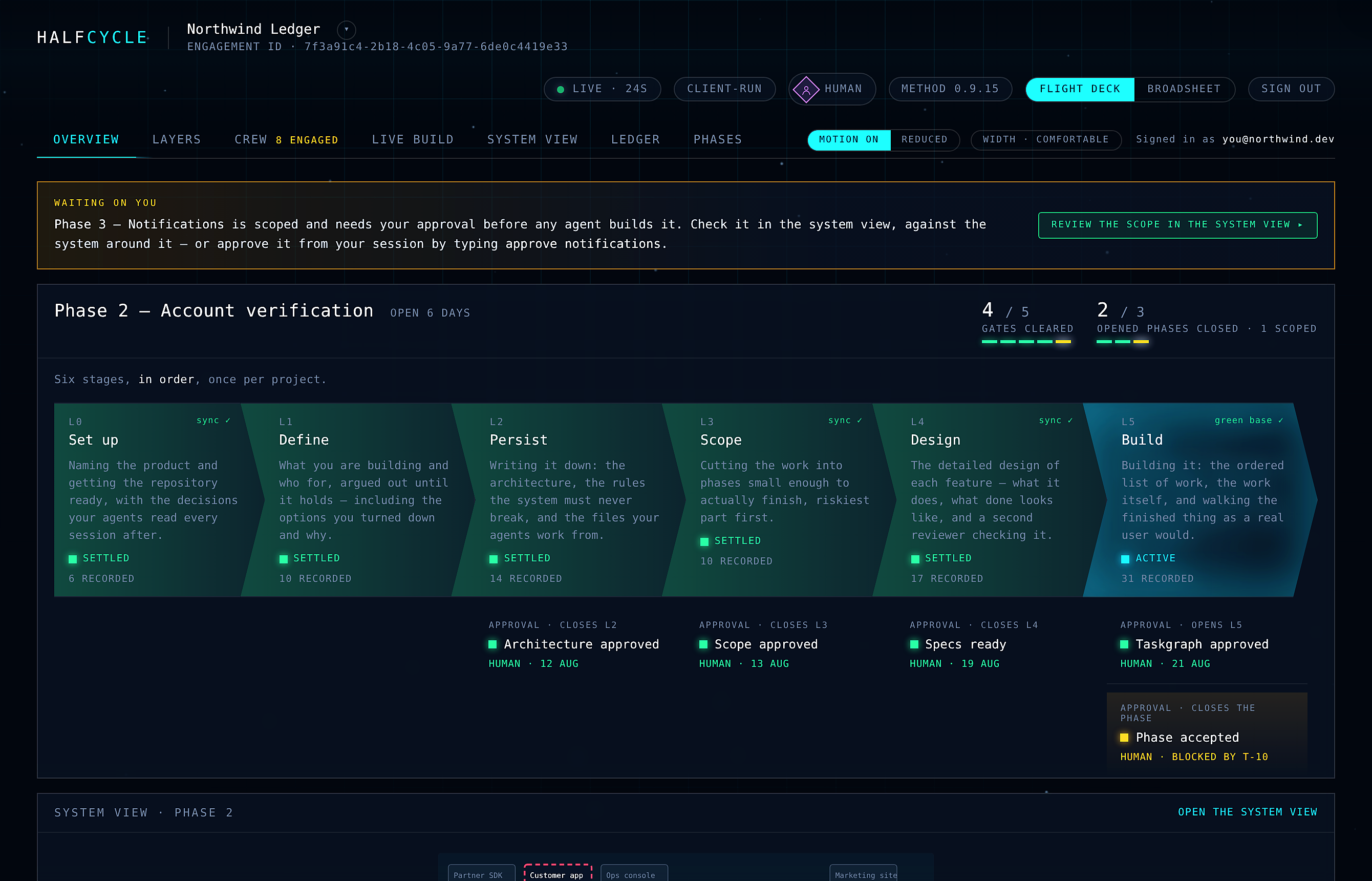
One page per project, written for a person who does not open terminals
What is waiting on you, where each phase is, what passed and what was
stopped and why, who approved what and when, and what it has cost. The
same page your engineers use.
What it never shows: file contents. Halfcycle holds no access to your
repositories. Where the page points at code, it links to your own
remote, under your own permissions.
What your engineers see
The agents at work, and the system they are building
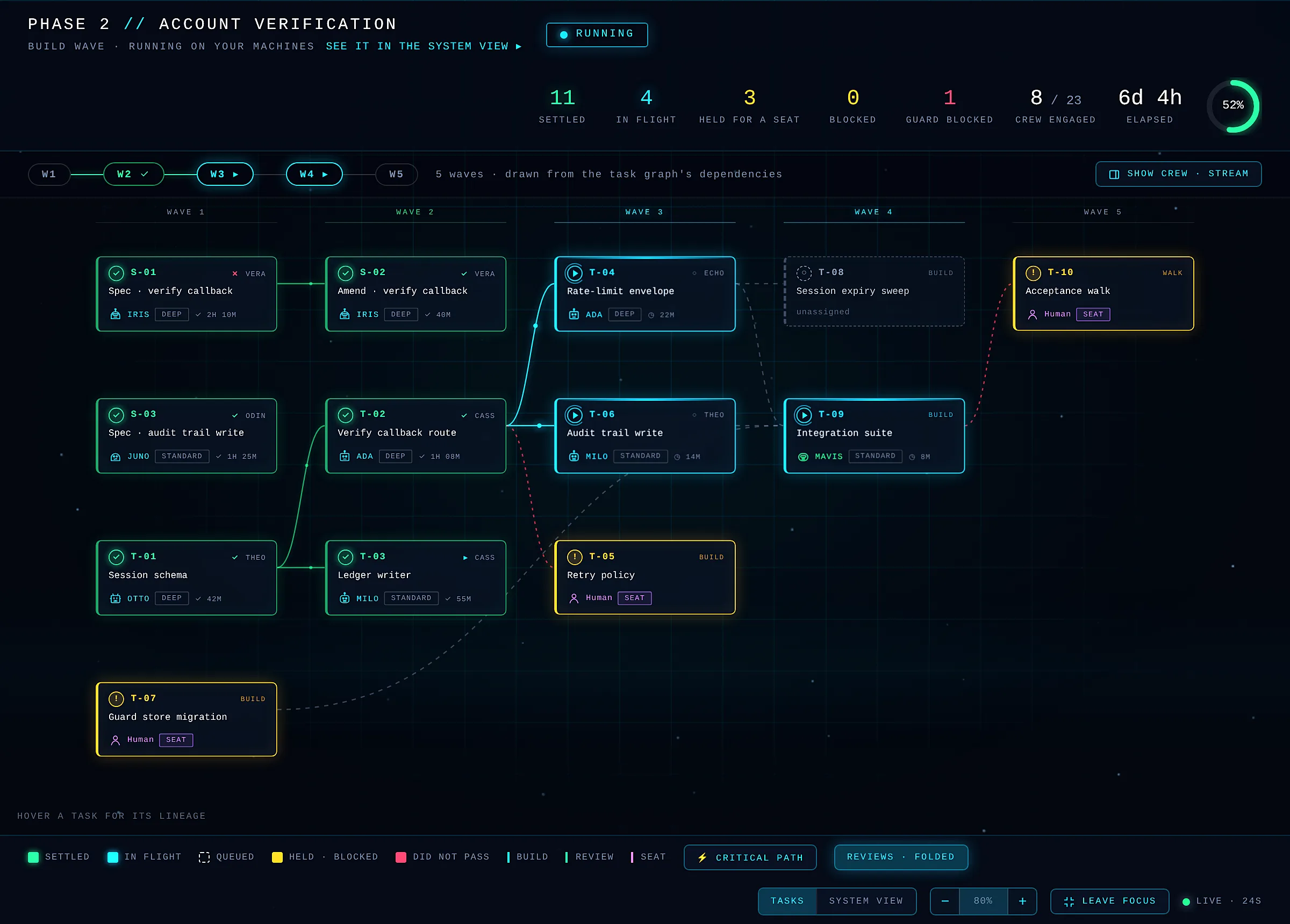
The live build: every task in the phase, the agent on each one, what
has passed review and what is waiting on a person.
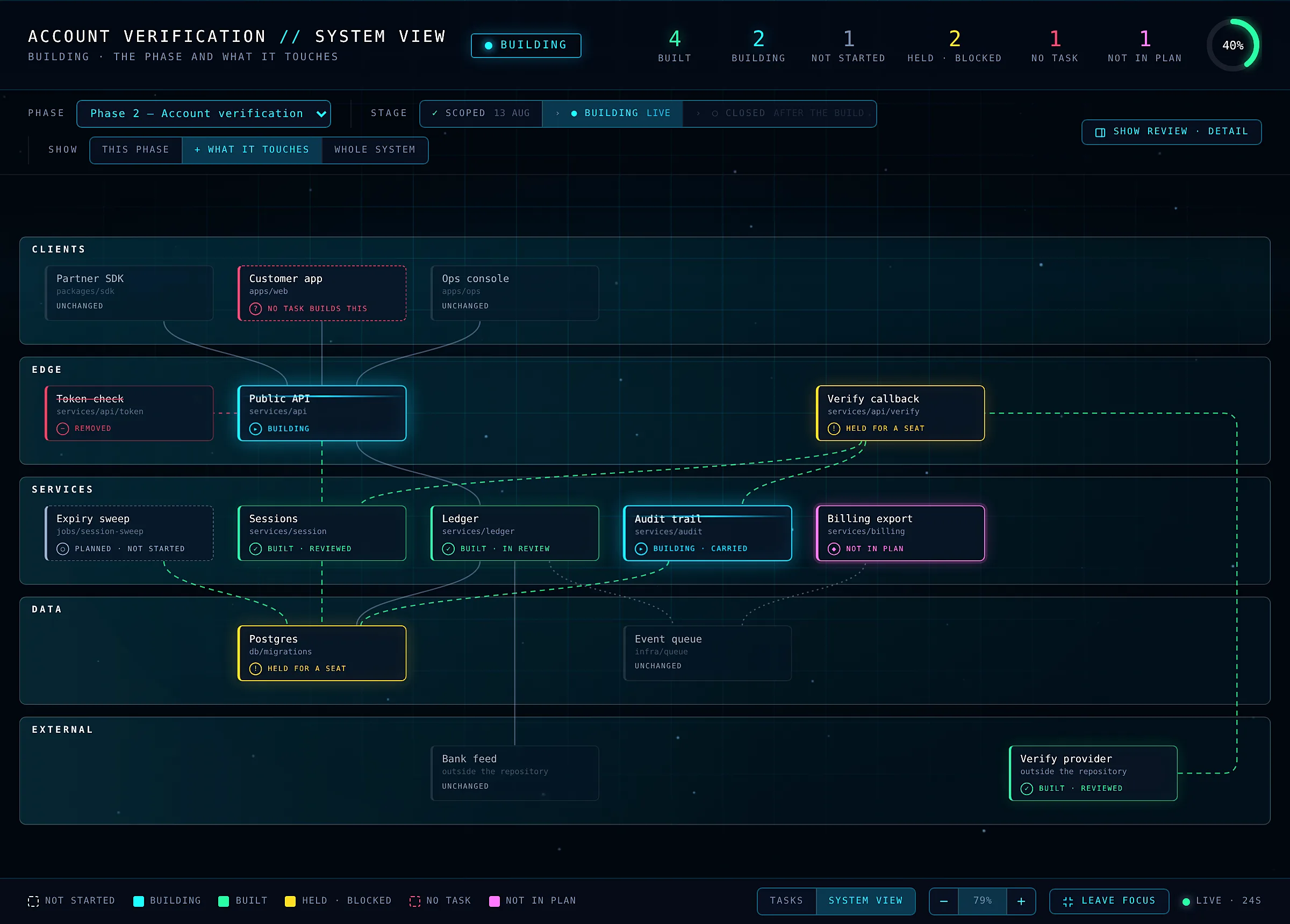
The system view: each part of the product and how they connect, with
what is built, what is being built and anything a change touches that
no task covers.
Four ways we come in. Every one ends with your team running it.
Each one is a fixed fee, quoted for your team before it starts.
Get in touch for a quote. No hourly billing
anywhere.
Quoted on request
Two weeks · fixed fee
The AI-Build Audit
For the leader who knows something is wrong and cannot yet say what.
We point the method at your repositories and read what it finds beside your incidents, your review process and your agent spend. Two weeks later you know what to change first, what to change next, and what each is worth.
You get
Your repositories read by the method, every finding pointing at a line
Your incidents, your review process and your spend read beside it
A written finding: what is costing you, in what order to fix it
A sequence your team can run with us or without us
Yours whether you go on with us or not. A fair number of teams take the audit and run the sequence themselves.
For the organisation where "install it" will not happen on its own.
Four weeks on your repositories, with your team, shipping real work. We drive the first week. Your engineers drive the last. It ends with a baseline you can take upstairs and the whole team on the Team plan.
You get
Real production work shipped on your own repositories
Every engineer on the Team plan, with the same checks on every edit
Your existing code read and reconstructed, layer by layer
Your rules written in and running on every project
A page per project with cost and cycle time, and one for all of them
A written baseline and a recommendation for what comes next
The price sits beside the Team plan, not instead of it.
For the company that wants the software more than the capability.
One phase of your product, built on the method, with your engineers in the room so the capability arrives anyway. The price is set when the spec is signed off, so it is about the work and not a guess at it.
You get
A phase of working software, walked on the deployed product before it closes
Part of the price held until you accept it
A fixed period after delivery in which we stand behind the work
Organisation rules, single sign-on, your tracker, training, governance, across more teams than a pilot covers. There is no package, because no two of these look alike.
Also for
A services firm that wants to deliver its own client work on the method. We run your first client engagement with you, then get out of the way.
Real work, not a workshop. By the fourth week your engineers are running
a phase without us, and that is the test the pilot has to pass.
The adoption pilot · four weeks
Responsibility moves to your team, a week at a time
Week 1We driveYour repositories read and reconstructed. Your organisation set up. The production work chosen.
Week 2We guideReal work ships. Every change checked. Your engineers at the keyboard.
Week 3We guideYour rules written in. A second team joins. We step back a pace each day.
Week 4You runYour team runs a phase without us. We write the baseline and the recommendation.
Ends with your team on the Team plan, running the method without us.
What every engagement ends on
The Team plan: one way of working, every change checked, every project on one page
A lead with one or two repositories and a willing team does not need us.
Start the trial, invite the team, and be on it this afternoon. Each
change is checked where most defects actually live: in the join between
two pieces of work that each passed their own tests.
01
One way of working on every seat
Invite by email or by link. A colleague's next npx halfcycle in a clone of the repository puts them on the project with the role you gave them. Nothing to install beyond the one command, nothing to configure, nothing to keep up to date.
02
Every change checked by an agent that did not write it
On every edit, in the session, before review. What was stopped says why. Your reviewers read code that has already been read.
03
Every project on one page, with its cost
Phase, what is happening now, what is waiting on whom, what the phase has cost in money and how long it has taken. One page per project and one for all of them. Share it with your own lead as a read-only link.
04
Your rules, on every project
An Admin writes a rule once: a convention, a check, a step your organisation needs. It runs on every project from the next edit, and says where it came from when it fires. Your rules add to Halfcycle's. They cannot switch one off.
05
Approval is a person's act
Owner, Admin, Write and Read, the way GitHub does it. Who may approve a phase's scope or close one is named per project, with a second approver when you want one. Every approval is recorded by name.
06
It starts with the code you have
It reads an existing repository before it writes anything, shows you what it sees, and reconstructs the plan from the code with every claim pointing at a line. A product spread over several repositories is one project with one page.
In phases of several hundred tasks, each change checked as it is
written, each phase closed only on a walk of the deployed product by
somebody who did not build it. Four other products have been built on it
from their first phase, from a two-person company's first product to a
platform with paying customers, each delivered well inside the time a
standard team had estimated for it. We will show you the records on the
call. Why the method keeps improving, and one real feature with every
defect the review found, are on how it works.
Series B platform
Velocity that stopped tracking headcount
Each new engineer added coordination cost faster than throughput. The
finding was not tooling. Four teams were writing specs that quietly
assumed contradictory things.
Two previous attempts had produced architecture documents and no
shipped change. The third shipped because the work was cut into
phases that could close.
The agents run in your own Claude Code or OpenAI Codex, on your own
accounts, on your own machines. We never hold or proxy the credential.
Nothing in your repository is copied to us. Every phase closes with a
written record an auditor can read, and every approval is a named
person's act.
The full statement, written for the person who signs off on a tool, is
on the governance and data page. It includes
what the method does not do, because that list is what makes the rest
believable.
Bring us the stalled rollout
Thirty minutes with the person who would run the engagement. Tell us
what is stuck, what deadline matters and what you have already tried. We
will tell you on the call whether to install it and go, book the audit,
or wait.
 Anthropic startup programme
 Claude Code
 OpenAI Codex
 nuCode Tech Capital